Plant Leaves Curling: Causes and Fixes in Hydroponics
Leaves curling up means heat or light stress. Curling down often means dissolved oxygen below 3.8 mg/L. Use curl direction and leaf age to find your cause.
In this guide
Your reservoir is full. The pump is running. The leaves are curling anyway.
That rules out the answer nearly every gardening page leads with. In soil, curled leaves usually mean underwatering. In hydroponics the water is right there against the roots, so thirst is not the explanation.
Curling means something else: the plant cannot move water fast enough, or it is deliberately shrinking its exposed surface. Curl direction and leaf age tell you which.
Some links in this article may be affiliate links. We earn a small commission if you purchase through them, at no extra cost to you.
The short version
- Curling up and cupping points at the air: heat, light intensity, or vapor pressure deficit.
- Curling down points at the root zone. Below roughly 3.8 mg/L of dissolved oxygen, roots stop moving water even in a full reservoir.
- Twisted, leathery new growth is pests or contamination, not nutrition, and it will not fix itself.
- Curled leaf margins are an early calcium delivery failure, usually the first stage of tipburn.
- Unlike yellow or brown leaves, curled leaves often flatten back out within hours of the right fix.
What does the direction of the curl tell you?
Direction separates the atmosphere from the root zone. Up means the leaf is shielding itself from what is above. Down sends you below the net pot.
At a glance: reading the curl
| Curl shape | Cause family | First thing to do |
|---|---|---|
| Cupping upward | Heat, light, high VPD | Raise lights, check canopy temp |
| Clawing downward | Root zone oxygen or disease | Lift a plant, inspect roots |
| Twisted, rigid, new growth only | Pests or contamination | Inspect tips under magnification |
| Margins rolling under | High EC, calcium not reaching edges | Lower EC, add airflow |
Leaf age refines the reading. Symptoms on the leaves closest to the fixture point at the light. Symptoms spread evenly, or starting on older lower leaves, point at the roots.
Why are leaves curling upward? Heat, light, VPD
When the air pulls water from a leaf faster than the roots can replace it, the stomata close and the margins roll up to trap humid air against the surface. Writing in New Phytologist, Grossiord and colleagues describe the trade: stomata shut to avoid dangerous tension in the xylem, and photosynthesis drops as the price.
Vapor pressure deficit governs this, and it gives you a number to aim at. Michigan State University Extension puts the working range like this:
| VPD | What happens |
|---|---|
| Below 0.3 kPa | Air near saturation, plants cannot transpire, disease risk climbs |
| Above 0.5 kPa | Minimum for finishing plants to transpire and cool themselves |
| Around 0.8 kPa | Improved photosynthesis and yields in greenhouse vegetables |
| 2.2 kPa | Enough to cause stress and fruit cracking in tomato |
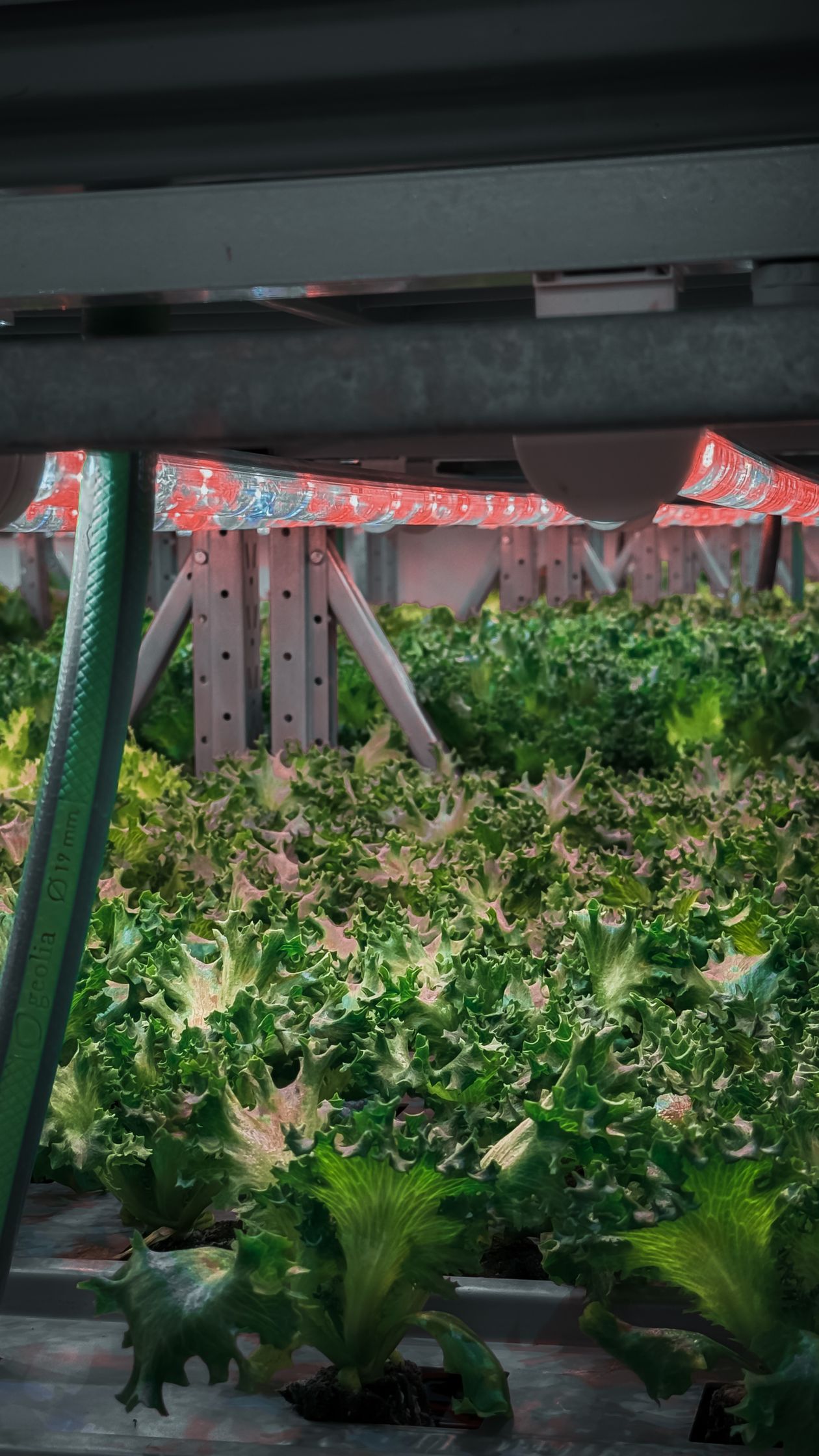
Light intensity does the same damage by a different route, and this is where indoor growers go wrong. Butterhead lettuce grown at 150, 200, 250 and 300 micromoles per square meter per second showed a significant rise in tipburned leaves as intensity climbed. The part that matters: calcium rose in the whole plant and the outer leaves, but not in the inner enclosed leaves.
That is why a calcium supplement so often does nothing. The calcium is in the plant. Faster growth just means it never reaches the tissue that curls.
How do you fix upward leaf curl?
Commercial growers fix this with spectrum, and one romaine study cut tipburn from 49% to 25% using green light. At home, the fix is mechanical.
- Raise the fixture. Adjustable rope hangers make this a 10-second change. Drop the intensity at canopy height before touching the reservoir. If only the leaves under the light are cupping, this is almost always it.
- Measure canopy temperature, not room temperature. An infrared thermometer reads leaf-surface temperature under the light in a second. NC State Extension puts lettuce at 60 to 65 F (15.5 to 18.3 C), with 80 to 85 F tolerable only briefly and only with cool nights.
- Add horizontal airflow. An oscillating fan breaks up the still, humid pocket on the leaf surface so the plant can transpire again.
- Target VPD, not a humidity number. Aim at 0.8 kPa. Relative humidity alone tells you nothing without the temperature beside it, so use a combined hygrometer and thermometer and read both together.
Upward cupping usually arrives just ahead of brown, crispy leaf tips. Catching it at the curl stage is the cheap version of that problem.
Why are leaves curling downward? Roots and oxygen
Downward curl, the shape growers call clawing, points at the roots. A full reservoir is not the same as roots that can use it.
Dissolved oxygen is the mechanism. Research on hydroponic pepper tested solution at 1.8, 2.6, 3.8 and 5.3 mg/L and concluded oxygen must not fall below the 3.8 to 5.3 band. Below that the solution is hypoxic: root respiration drops, water uptake drops with it, and uptake of potassium, magnesium, calcium, phosphorus and sulfur falls away.
The plant is then sitting in water it cannot drink.
Warm water makes it worse, since oxygen solubility falls as temperature rises. That is the same slide that ends in root rot. So the fastest split here is not a leaf symptom at all. Lift a plant and look.
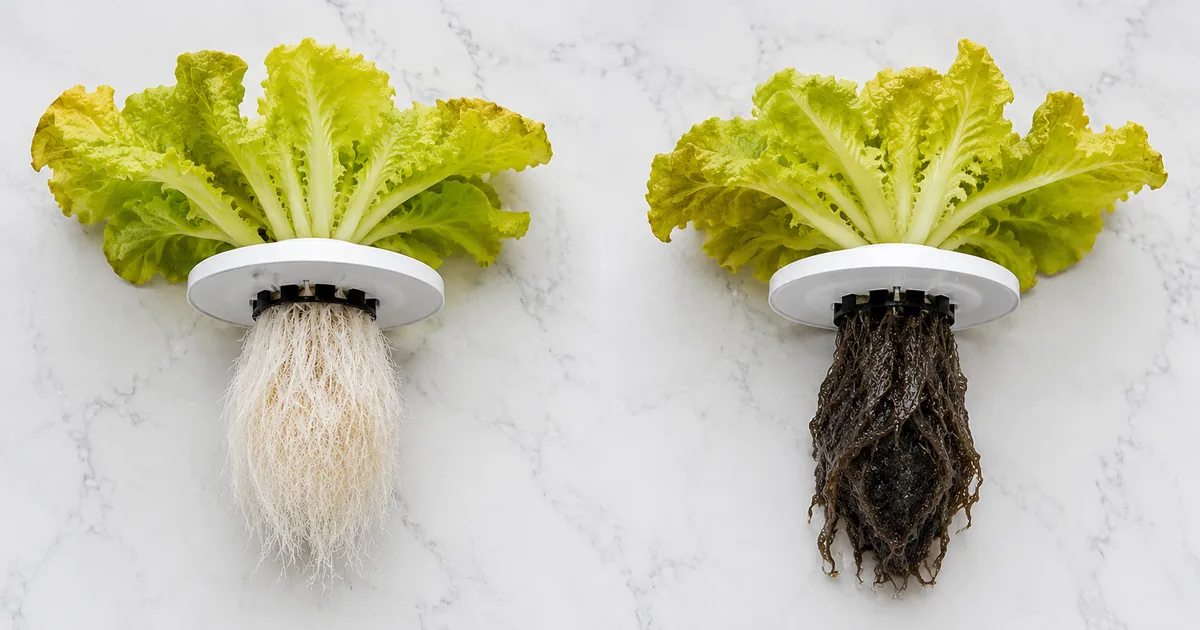
White, firm and odorless means healthy roots, so treat it as oxygen and temperature: add aeration, cool the reservoir. Brown, soft or swampy-smelling means active rot, which gets isolated and treated before anything else.
This is the 60-second root check, and it resolves more hydroponic diagnoses than any leaf chart, including this one.
What causes twisted new growth?
If the distortion is confined to the newest leaves, and those leaves feel rigid or leathery rather than soft, stop thinking about nutrients.
Broad mites (Polyphagotarsonemus latus) feed at the growing tip and inject saliva toxic to plant tissue. At 0.2 mm, roughly half a two-spotted spider mite, Rutgers Plant and Pest Advisory notes they are effectively invisible in routine scouting and hard to find even with a hand lens.
UConn IPM describes the damage precisely: leaves twisted, hardened and distorted, lower surfaces bronzed, a downward puckering along the edges. At high populations the growing point dies outright. Two details matter:
- It mimics herbicide injury, nutrient deficiency, and cold damage, which is why it gets misdiagnosed.
- It persists long after the mites are gone, so fixing the environment will not unroll those leaves.
Confirm under a dissecting microscope, or a 20x hand lens with practice, and look for elliptical eggs covered in whitish diamond-patterned bumps. Thrips twist growth too, but leave silver scarring and black specks of frass.
Why do leaf margins curl under?
When the blade stays flat but the margins roll under, calcium delivery is failing at the edges. Calcium moves passively with transpiration, so it goes where water goes. Push growth with a high EC and the fastest-expanding tissue outruns its own supply.
Same paradox as the light research, different route. The fix is to slow the plant, not feed it more: lower EC toward the bottom of your target band and move more air across the canopy. The EC and pH basics guide covers where those bands sit by crop.
The curl diagnostic chart
| Curl direction | Leaves affected | Roots | Likely cause | First action |
|---|---|---|---|---|
| Upward cupping | Newest, nearest the light | White, firm | High VPD, canopy heat, or excess intensity | Raise lights, target 0.8 kPa VPD |
| Downward clawing | Spread across the plant | White, firm | Low dissolved oxygen, warm reservoir | Add aeration, cool the reservoir |
| Downward clawing | Whole plant, wilting too | Brown, slimy | Root rot | Isolate and treat, do not feed |
| Twisted, rigid | New growth only | White, firm | Broad mites or thrips | Inspect tips under magnification |
| Margins rolling under | Fastest-growing leaves | White, firm | High EC, calcium transport failure | Lower EC, add airflow |
| Thick leathery roll | Whole tomato plant | White, firm | Physiological leaf roll, harmless | None needed |
The bottom line
- Direction first, then leaf position. Up and near the light is atmospheric. Down and spread out is the root zone.
- Three numbers to hold: 0.8 kPa VPD, dissolved oxygen above 3.8 mg/L, lettuce at 60 to 65 F.
- More calcium rarely fixes curled margins. Slowing growth does, because calcium follows transpiration.
- Twisted new growth is the one cause that never resolves on its own. Confirm the pest first.
- Curling with a full reservoir is not thirst. If the plant has gone past curling into collapse, switch to wilting rather than curling. If it is yellowing too, work that chart alongside this one.
Curling leaves are one of eight patterns worth learning to read on sight. The full diagnosis and prevention guide covers all eight with the fix for each, plus the daily routine that catches heat, pH drift, and overfeeding before the leaves react.
Sources (8)
- Grossiord, C. et al. “Plant responses to rising vapor pressure deficit.” New Phytologist, 2020. Link Retrieved 2026-07-19.
- Runkle, E. “Why should greenhouse growers pay attention to vapor pressure deficit and not relative humidity?” Michigan State University Extension. Link Retrieved 2026-07-19.
- “Lettuce Production.” NC State Extension Publications. Link Retrieved 2026-07-19.
- “The responses of pepper plants to nitrogen form and dissolved oxygen concentration of nutrient solution in hydroponics.” PMC11015634. Link Retrieved 2026-07-19.
- “High Green Light Substitution Reduces Tipburn Incidence in Romaine Lettuce Grown in a Plant Factory with Artificial Lighting.” Plants, PMC12845428. Link Retrieved 2026-07-19.
- “Effects of Light Intensity and Growth Rate on Tipburn Development and Leaf Calcium Concentration in Butterhead Lettuce.” Link Retrieved 2026-07-19.
- “Scouting for Broad Mites in the Greenhouse.” Rutgers Plant and Pest Advisory. Link Retrieved 2026-07-19.
- “Managing Broad Mites on Greenhouse Crops.” UConn Integrated Pest Management. Link Retrieved 2026-07-19.