Root Rot vs Nutrient Deficiency: How to Tell the Difference
Yellow leaves in hydroponics mean root rot or a nutrient deficiency, and the fix for one worsens the other. A 60-second root check tells you which you have.
In this guide
Yellow leaves and wilting in a hydroponic system point to one of two things: root rot or a nutrient deficiency. The problem is that the fix for one makes the other worse. Feed a plant with root rot and you feed the infection. Sterilize a healthy system over a pH problem and you lose a week while the plant actually starves.
One inspection tells you which you’re dealing with, and it takes about a minute.
The short version
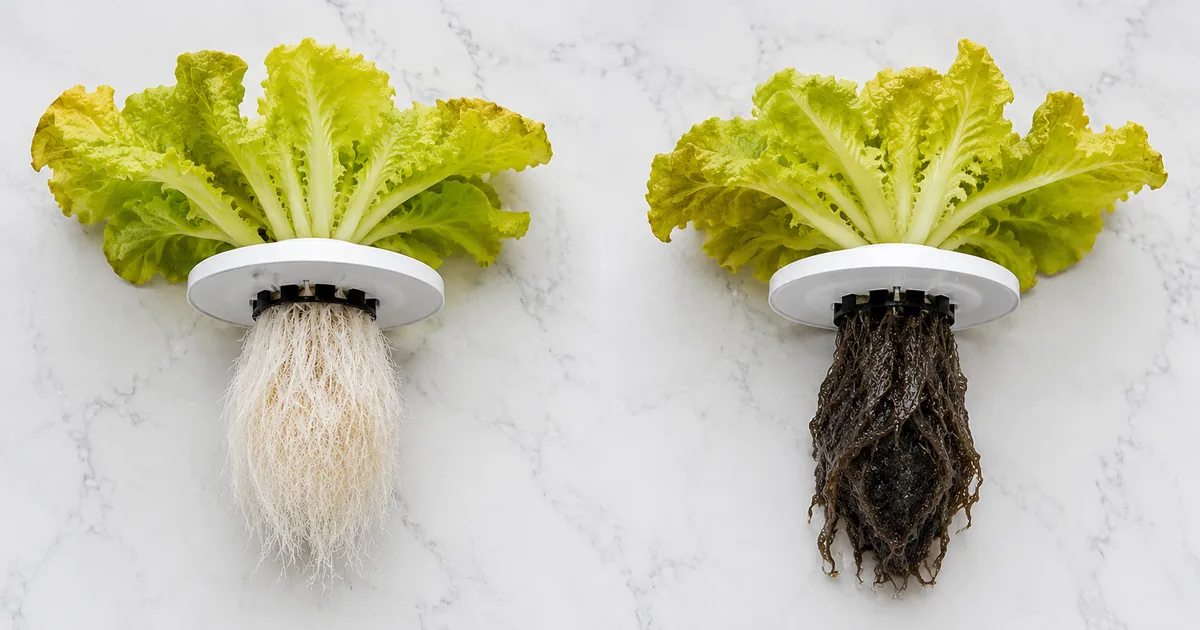
- Lift the plant and look at the roots before you adjust anything. White and firm means chemistry. Brown, slimy, or foul-smelling means rot.
- Root rot mimics deficiency because rotting roots can't absorb. The plant looks starved with a full reservoir.
- Old leaves affected first points to a mobile nutrient. New growth affected first points to an immobile one, or to high pH.
- pH drift causes most apparent deficiencies in an otherwise healthy system. Check it before you touch the nutrient bottle.
- If you find both, treat the rot first. Chemistry fixes do nothing while the roots can't absorb.
What is the fastest way to tell the difference?
The 60-second root test: lift the plant out of its net pot or channel and hold the root mass under clear light. This one step answers the question faster than any leaf symptom will.
At a glance: what the roots are telling you
| Root appearance | Diagnosis | Next step |
|---|---|---|
| White or cream, firm, distinct fine threads | Nutrient deficiency or pH drift | Test and adjust reservoir pH, then EC |
| Brown, gray, or black, slimy, mushy, swampy smell | Root rot (Pythium) | Isolate the plant, sterilize the system, trim the roots |
A tint from colored nutrient solution is normal as long as the structure stays firm. Smell is the clearest confirmation of active rot: healthy roots have no odor at all.
Why does root rot look exactly like starvation?
Pythium is a water-borne pathogen that colonizes the root zone and coats the roots, blocking their ability to take up water and nutrients. The plant above the waterline then starves. The leaf symptoms are identical to a deficiency because the underlying mechanism is identical: the plant isn’t getting fed either way.
That’s the trap. A plant with advanced rot wilts while sitting in a full reservoir and yellows with perfect pH and EC readings. Adding nutrients does nothing, because the delivery system is what’s broken.
Two conditions cause most outbreaks. Warm solution comes first: dissolved oxygen falls as temperature rises, and Colorado State Extension puts the optimal root zone at 68 to 72°F (20 to 22°C) with dissolved oxygen above 6 ppm. Poor aeration is the second: a failing pump, a blocked line, or an undersized air stone creates the low-oxygen conditions Pythium needs to establish.
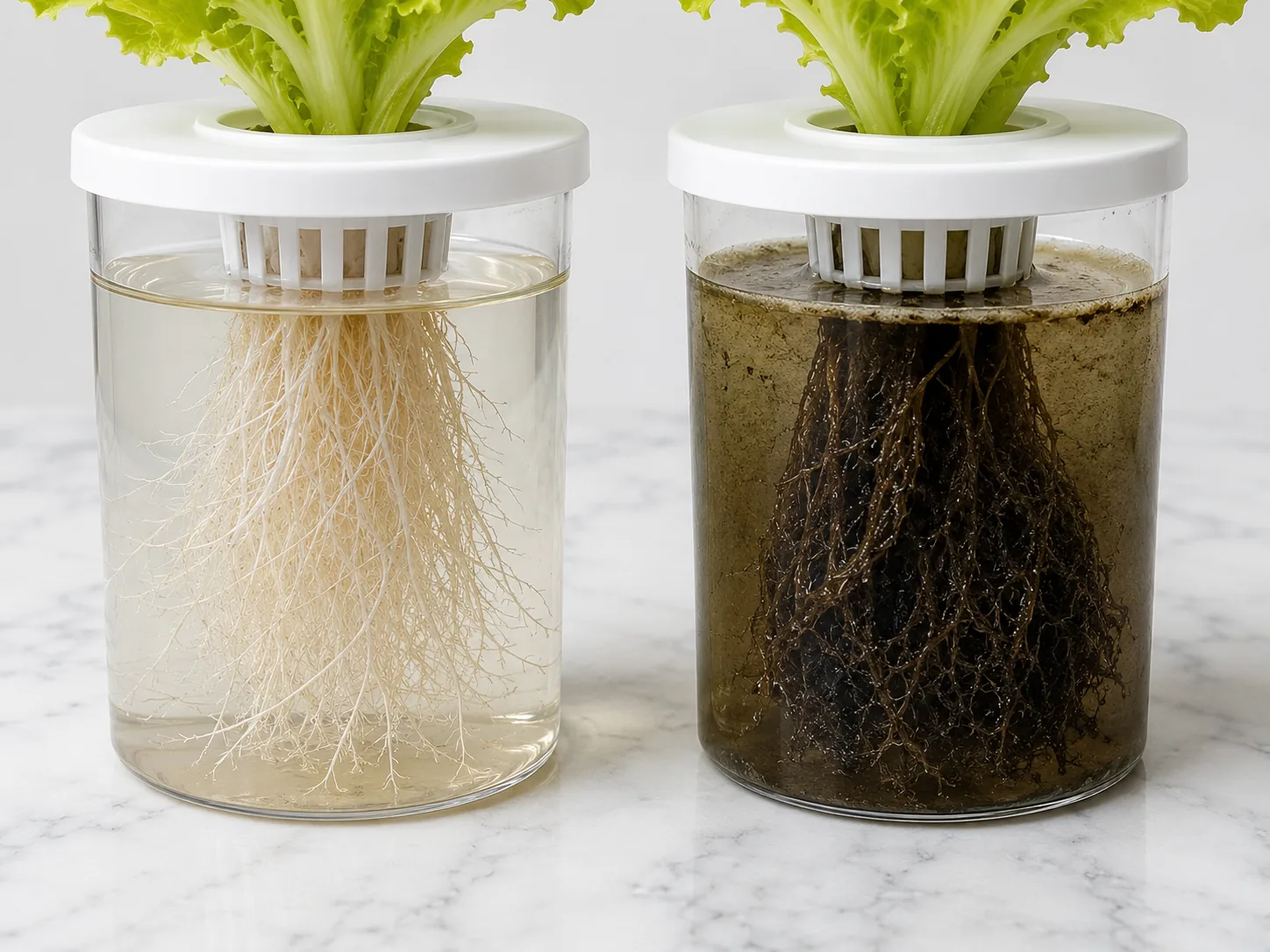
If the roots confirm rot, act immediately. Pythium releases motile zoospores that travel through shared water and can reach every plant in a DWC reservoir or NFT channel within hours. Pull the infected plant out of shared water first, then work through the full treatment and prevention protocol in our guide to hydroponic root rot.
What if the roots look clean and healthy?
White, firm roots mean the problem is chemistry. The most useful diagnostic isn’t the color of the yellowing, it’s where on the plant it starts, which depends on whether the nutrient can move within plant tissue.
| Nutrient type | Nutrients | Where symptoms appear first |
|---|---|---|
| Mobile | Nitrogen, phosphorus, potassium, magnesium | Older, lower leaves, spreading upward |
| Immobile | Calcium, iron, zinc, manganese | Newest leaves, while old leaves stay green |
Mobile nutrients relocate out of old tissue to support new growth when supply runs short, so the plant sacrifices its oldest leaves first. Immobile nutrients can't move once deposited, which is why new growth suffers while older leaves look fine (Cornell NRCCA; MSU Extension).
From there, the specific nutrient follows from the pattern. Yellowing that starts low and even usually means nitrogen; yellowing between the veins of old leaves means magnesium; the same net pattern on new leaves means iron. Our yellow leaf guide walks each one through with the vein patterns side by side.
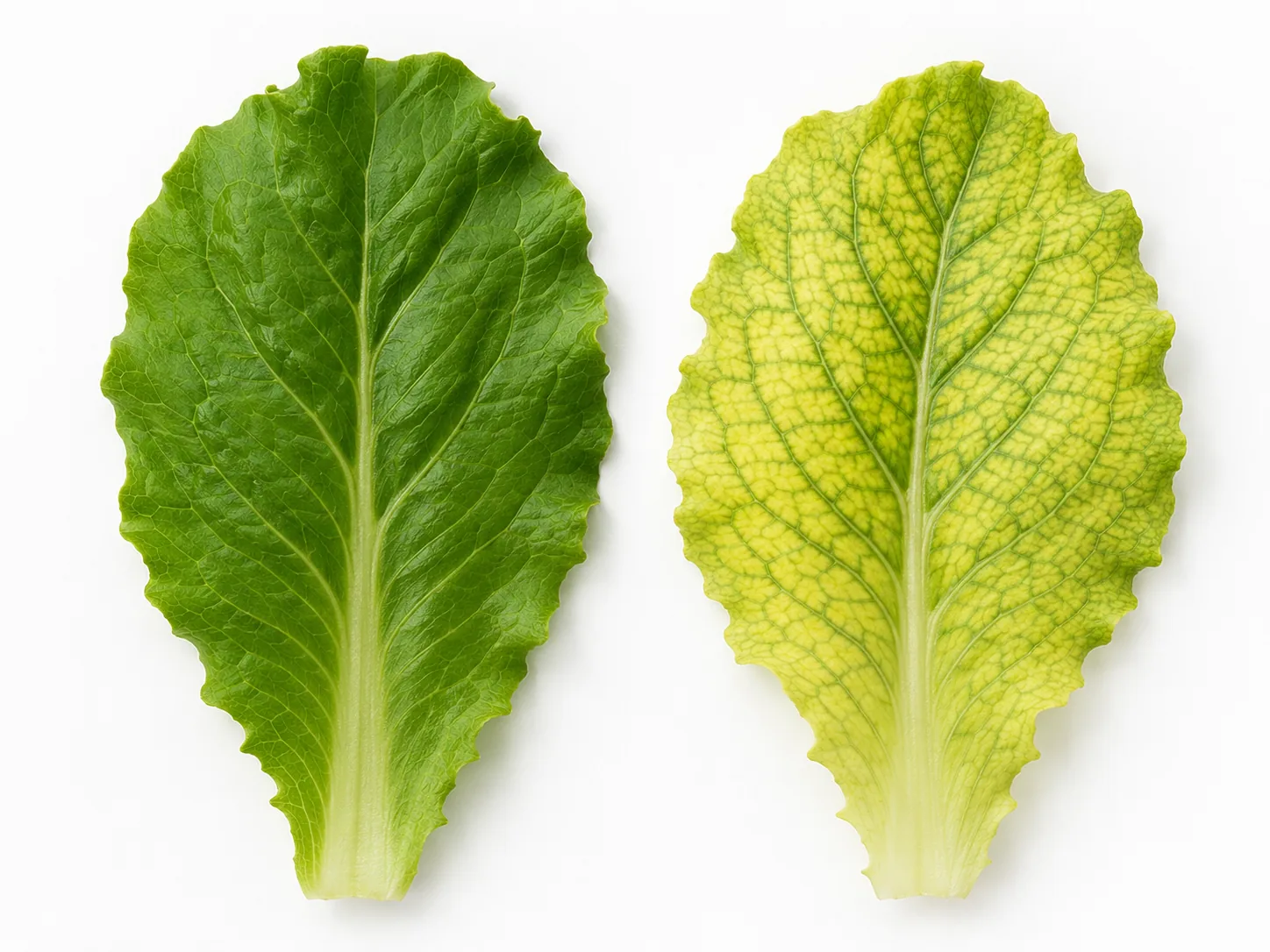
Brown rather than yellow narrows it differently. Scorched margins on older leaves point to potassium, and dead tips or cupped new leaves point to calcium, which is often an airflow problem rather than a supply one. Both are covered in brown leaf tips.
Is pH drift the real problem?
Most apparent deficiencies in a healthy system trace back to pH drift, not a missing nutrient. Most crops absorb efficiently between pH 5.5 and 6.5. Outside that window specific nutrients lock out even at correct concentrations: iron becomes unavailable as pH climbs above roughly 6.5, and calcium and magnesium drop off below 5.5.
Correct pH before you change anything else. If symptoms ease within three to five days, that was your answer. The full mixing and lockout breakdown is in pH and nutrients for beginners.
How do you know which problem you have?
- What do the roots look like? White and firm means chemistry. Brown, slimy, or smelly means rot. If they're clearly one or the other, you're done here.
- Which leaves are affected? Old leaves first means a mobile nutrient or rot. New growth first means an immobile nutrient or high pH. Everything at once means rot, a pH crash, or EC far out of range.
- What do the numbers say? Test pH and EC before assuming anything is missing. A reading outside 5.5 to 6.5 explains most leaf symptoms on its own.
One symptom deserves its own note. Wilting despite a full reservoir is the single most reliable pointer toward the root zone rather than the nutrient mix, because it contradicts what the grower expects to see. If that’s your main symptom, start with wilting in hydroponics.
What to fix next
Get reservoir temperature, aeration, and pH dialed in and most of these problems either don’t develop or stay small enough to catch early. If you’re seeing brown biofilm alongside the leaf symptoms, there’s overlap worth reading in preventing hydroponic algae.
Frequently asked questions
Can root rot cause the same symptoms as a nutrient deficiency?
Yes, and that’s exactly why it gets misdiagnosed. Rotting roots can’t absorb water or nutrients, so the plant shows starvation symptoms above the waterline even when the reservoir is full and correctly mixed. Leaf symptoms alone can’t separate the two. The root inspection can.
My pH and EC are perfect but leaves are still yellowing. What's happening?
Inspect the roots directly. Partial root rot develops slowly enough that leaf symptoms show up before the root mass turns visibly brown. Look for a few brown, slimy tips hiding among otherwise healthy white roots, and treat it as early-stage rot.
My roots have brown tips but no slime and no smell. Is that root rot?
Probably not. Nutrient solutions containing iron chelates stain roots tan or brown without harming them. Stained roots stay firm and have no odor. If you’re unsure, squeeze a small section: healthy roots hold together, rotting roots disintegrate.
Which should I fix first if I find both problems?
Root rot, every time. Until the roots can absorb again, correcting pH or EC changes nothing the plant can actually use. Clean up the root zone and reservoir first, then dial in the chemistry once you see new white root growth.
Sources (5)
- Colorado State University Extension, “Root Disease Problems & Management in Hydroponic Systems,” PlantTalk Colorado 2043, retrieved 2026-07-19, https://planttalk.colostate.edu/topics/miscellaneous/2043-root-disease-problems-management-hydroponic-systems/
- Cornell University, “Mobile and Immobile Macronutrients,” Nutrient Management Spear Program (NRCCA), retrieved 2026-07-19, https://nrcca.cals.cornell.edu/nutrient/CA1/CA0104.php
- Michigan State University Extension, “Knowing nutrient mobility is helpful in diagnosing plant nutrient deficiencies,” retrieved 2026-07-19, https://www.canr.msu.edu/news/knowing_nutrient_mobility_is_helpful_in_diagnosing_plant_nutrient_deficienc
- Mattson, N., “Symptoms of Common Nutrient Deficiencies in Hydroponic Lettuce,” e-GRO Edible Alert, Cornell University, retrieved 2026-07-19, https://www.e-gro.org/pdf/Mattson_Lettuce_2015_9.pdf
- University of Missouri Extension, “Hydroponic Nutrient Solutions,” G6984, retrieved 2026-07-19, https://extension.missouri.edu/publications/g6984