10 Common Hydroponic Mistakes (and How to Fix Each One)
Most hydroponic problems trace back to 10 fixable habits. From guessing at pH instead of testing to skipping water changes, here's what to fix first.
In this guide
- 1. Guessing at pH Instead of Testing It
- 2. Overfeeding the Nutrient Solution
- 3. Using Untested Tap Water
- 4. Underestimating Light Intensity and Duration
- 5. Starving the Root Zone of Oxygen
- 6. Letting the Reservoir Run Warm
- 7. Skipping Reservoir Water Changes
- 8. Growing a Heavy Feeder in the Wrong System
- 9. Ignoring Airflow Above the Canopy
- 10. Trusting an Uncalibrated pH/EC Meter
- The bottom line
Most “why is my plant dying” questions trace back to the same short list of habits. None of them are exotic failures. They’re small, repeatable oversights that soil would normally forgive and hydroponics won’t.
That’s really the whole story of soilless growing: no dirt means no buffer. Here’s what tends to go wrong, why it happens, and the specific fix for each one.
Some links in this article may be affiliate links. We earn a small commission if you purchase through them, at no extra cost to you.
The short version
- Untested pH, overfeeding, and warm reservoir water cause most of the damage growers blame on other things.
- Every mistake here has a physical mechanism behind it, not just a rule of thumb, and a cheap, specific fix.
- Testing and calibration habits (pH, EC, meter accuracy) prevent more failures than any piece of equipment.
- A full reservoir change every 7 to 14 days beats topping off every time.
At a glance: target ranges
| Parameter | Target range | What drifting out of range does |
|---|---|---|
| Solution pH | 5.5-6.5 | Locks out nutrients even when they’re present |
| Solution EC | 1.0-2.4 mS/cm (crop-dependent) | Osmotic stress, root tip burn |
| Reservoir temp | 65-70°F (18-21°C) | Less dissolved oxygen, faster pathogen growth |
| Dissolved oxygen | 5.0 mg/L or higher | Root suffocation, blocked nutrient uptake |
1. Guessing at pH Instead of Testing It
Most crops need a pH between 5.5 and 6.5 to keep nutrients dissolved and available. Drift outside that window and minerals undergo chemical reactions that make them insoluble, so a tank full of nutrients can still starve a plant.
Go too acidic and calcium and magnesium lock out while aluminum and manganese climb toward toxic levels. Go too alkaline and iron, manganese, and phosphorus precipitate out as solids the roots can’t use.
Fix it: test with a calibrated digital pH meter after fertilizers are fully mixed in, then adjust with a mineral acid like phosphoric acid rather than vinegar, which breaks down fast and feeds bacteria. Our pH and EC mixing guide walks through the full process.
2. Overfeeding the Nutrient Solution
More fertilizer does not mean faster growth. Pushing electrical conductivity (EC) past a crop’s tolerance raises osmotic pressure in the root zone, and roots pull water through osmosis along a pressure gradient they can no longer win.
The result is what growers call “chemical drought”: a plant sitting in a nutrient-dense tank that still can’t absorb water. Too much of one ion (potassium is a common culprit) also crowds out others, blocking nitrogen, calcium, and magnesium uptake.
Fix it: dilute with plain RO or distilled water until EC drops back into the crop’s range, then prune any damaged leaves. Watch for yellowing leaves as your early warning sign.
3. Using Untested Tap Water
Municipal water varies a lot, and most of it wasn’t formulated with your plants in mind. Chlorine and chloramine, added to kill pathogens in drinking water, also oxidize root hairs and wipe out the beneficial microbes in your system.
Hard water brings another problem: bicarbonate buffers the solution’s pH upward, so it keeps rebounding no matter how much acid you add. High background mineral content also eats into the EC budget you need for actual fertilizer.
Fix it: test baseline tap water with a TDS meter. Above roughly 150 ppm, or with any chloramine present, a reverse-osmosis filter with a carbon stage gives you a clean baseline to build from.
4. Underestimating Light Intensity and Duration
Weak or short lighting shows up as etiolation: stretched, leggy growth with thin stems and pale leaves reaching for more light than they’re getting. The real measure that matters is Daily Light Integral (DLI), the total light delivered to the canopy over 24 hours, not just how bright a fixture looks to your eye.
Leafy greens need meaningfully less DLI than fruiting crops like tomatoes, which burn through far more light energy building sugars and fruit.
Fix it: measure at canopy height with a PAR/PPFD quantum light meter, not a household lux meter, and adjust fixture height or photoperiod from there.
5. Starving the Root Zone of Oxygen
Roots breathe too. They need dissolved oxygen in the solution to actively pull in nutrients, and when levels drop below roughly 4 to 5 mg/L, that uptake stalls even in a well-fed tank.
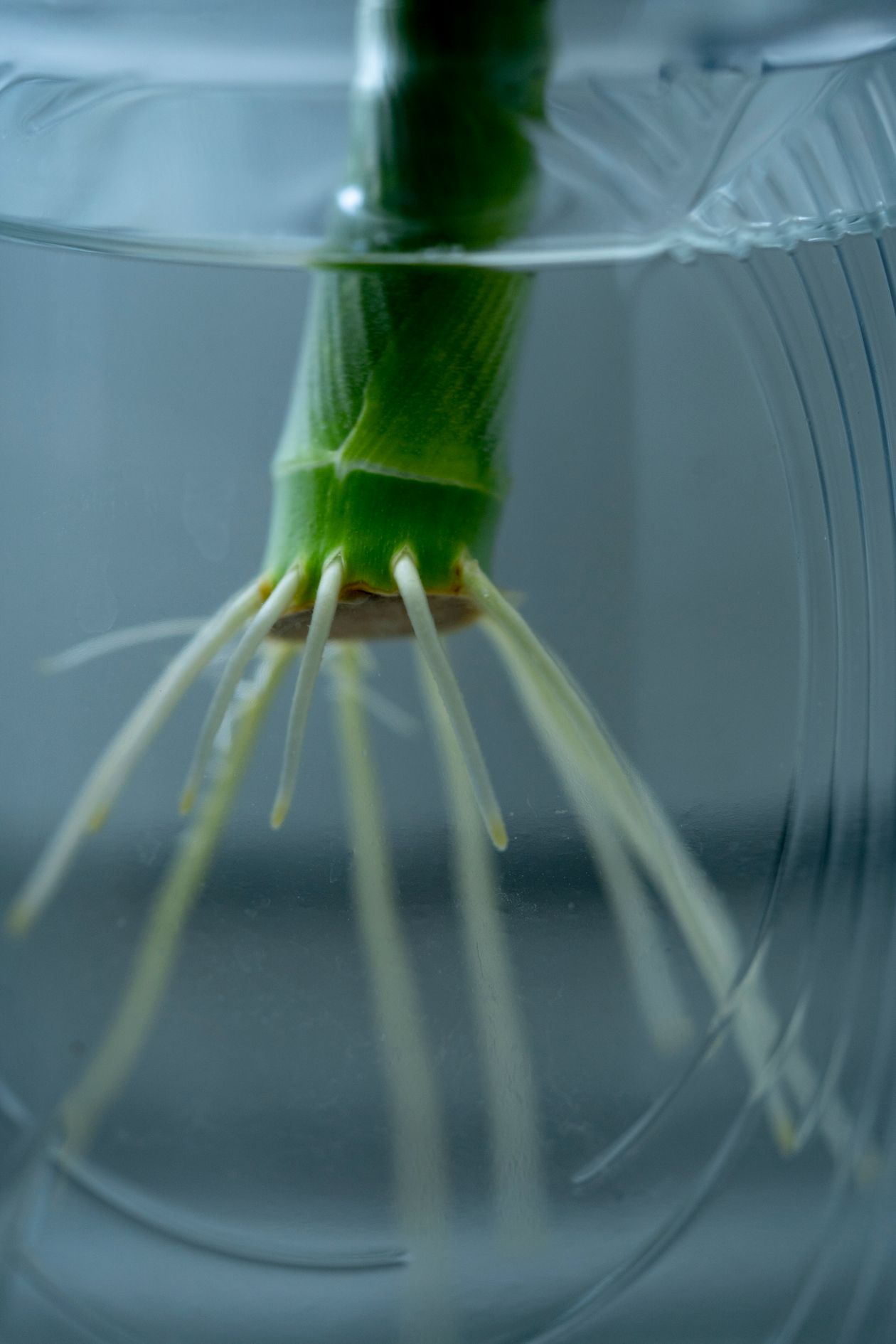
Starved root cells start to break down and leak sugars into the solution, which is exactly what draws in Pythium, the water mold behind most root rot. Fix it: run an air pump and air stone continuously, and in passive setups like Kratky or non-recovery DWC, leave an air gap above the water line so aerial roots can breathe. Our root rot guide covers diagnosis and recovery if it’s already happened.
6. Letting the Reservoir Run Warm
Warmer water holds less dissolved oxygen, full stop, and root respiration speeds up at the same time, so oxygen demand rises exactly when supply drops. That combination is exactly what pathogens like Pythium and Phytophthora are waiting for.
Keep the reservoir at 65 to 70°F. Above roughly 80°F, dissolved oxygen falls low enough that root rot becomes the likely outcome rather than a risk.
Fix it: insulate or paint the reservoir a light color, keep submersible pumps (which radiate heat) outside the tank if you can, and add an inline reservoir chiller if your grow space runs warm. More detail lives in our reservoir maintenance checklist.
7. Skipping Reservoir Water Changes
Plants don’t drink every nutrient at the same rate. Nitrogen and potassium disappear fast while calcium, magnesium, and sulfate linger, so a reservoir that only gets topped off slowly drifts out of balance even though the EC reading looks stable.
That’s the trap: EC measures total dissolved salts, not usable nutrition, so a “normal” reading can hide a real deficiency.
Fix it: do a complete drain, flush, and refill every 7 to 14 days, or once your cumulative top-offs equal the tank’s original volume, whichever comes first.
8. Growing a Heavy Feeder in the Wrong System
Every hydroponic system is built around specific hydraulics and root volume. A narrow NFT channel built for lettuce roots will clog and pool when an indeterminate tomato’s root mass fills it, and a low-volume wick system can’t move water fast enough to keep up with a heavy feeder’s transpiration.
Fix it: match the crop to the system. Save NFT channels and towers for fast, small-rooted crops like lettuce and herbs, and use a Dutch bucket kit or high-volume DWC for anything that grows into a large root system. Our hydroponic tomatoes guide covers system choice for heavy feeders specifically.
9. Ignoring Airflow Above the Canopy
Still air lets a humid layer build up right at the leaf surface, and that layer suppresses transpiration, which blocks the calcium transport plants rely on to build strong cell walls. The result is tip burn or blossom end rot even when your solution’s calcium is perfectly adequate.
Stagnant, humid air also gives fungal problems like gray mold and powdery mildew a place to start.
Fix it: run oscillating clip fans above and below the canopy for a light, constant breeze. It’s not just disease prevention either. Plants that get gently pushed around actually grow sturdier stems for it, which is more than can be said for most of us.
10. Trusting an Uncalibrated pH/EC Meter
A digital pH probe drifts over time as mineral film builds up on its reference junction, and there’s no warning light when it happens. A meter reading a comfortable 6.0 could be sitting on an actual 4.5 or 7.5, and you’d have no way to know without checking.
That’s how growers end up “correcting” a solution that was already fine, and pushing it straight into lockout or burn instead.
Fix it: calibrate pH pens weekly with a fresh two-point calibration buffer solution kit, calibrate EC pens monthly against a reference solution, and always store the probe in dedicated storage fluid, never dry and never in distilled water.
What is the single most common hydroponic mistake?
Leaving pH untested is the most frequent and damaging mistake in hydroponics. Without soil’s natural buffering, pH drifts outside the 5.5 to 6.5 window fast, and that locks out nutrients even when they’re sitting right there in the solution.
Can you overfeed hydroponic plants?
Yes. Too much fertilizer raises the solution’s electrical conductivity past what roots can handle, creating osmotic stress that blocks water uptake even in a nutrient-rich tank. It shows up as dark, curling leaves, tip burn, and lockouts from ion competition.
How often should hydroponic reservoir water be changed?
Plan on a full drain and refill every 7 to 14 days in a recirculating system, or as soon as your cumulative top-offs equal the reservoir’s original volume. Routine changes clear out the residual salts a top-off alone can’t touch.
Why do hydroponic roots turn brown or slimy?
Brown, slimy roots usually mean root rot, most often from a water mold called Pythium. Low dissolved oxygen, frequently caused by a reservoir running too warm, is what lets it take hold.
The bottom line
Nine times out of ten, hydroponic failures come down to a chemistry or oxygen habit slipping, not an unmanageable disease. Keep pH, EC, and reservoir temperature in range, keep the root zone oxygenated, and keep your meters honest.
- Test before you adjust: pH, EC, and tap water baseline, every time.
- Match your crop to your system’s hydraulics, not the other way around.
- Put a change schedule and a calibration schedule on the calendar, not just a “when it looks off” reminder.
New to hydroponics entirely? Start with our complete beginner’s guide for the full setup walkthrough.
Sources (12)
- Penn State Extension, Hydroponics Systems and Principles Of Plant Nutrition: Essential Nutrients, Function, Deficiency, and Excess, retrieved 2026-08-02, https://extension.psu.edu/hydroponics-systems-and-principles-of-plant-nutrition-essential-nutrients-function-deficiency-and-excess
- University of Florida IFAS Extension (EDIS HS1422), Growing Lettuce in Small Hydroponic Systems, retrieved 2026-08-02, https://ask.ifas.ufl.edu/publication/HS1422
- University of Kentucky Center for Crop Diversification (CCD-CP-63), Hydroponic Lettuce Production in Controlled Environments, retrieved 2026-08-02, https://ccd.uky.edu/sites/default/files/2024-11/ccd-cp-063_hydroponic-lettuce.pdf
- University of Massachusetts Extension, How to Use pH and EC “Pens” to Monitor Greenhouse Crop Nutrition, retrieved 2026-08-02, https://www.umass.edu/agriculture-food-environment/greenhouse-floriculture/fact-sheets/how-to-use-ph-ec-pens-to-monitor-greenhouse-crop-nutrition
- University of Massachusetts Extension, Soluble Salts and Electrical Conductivity (EC) for Greenhouse Crops, retrieved 2026-08-02, https://www.umass.edu/agriculture-food-environment/greenhouse-floriculture/fact-sheets/soluble-salts-electrical-conductivity-ec-for-greenhouse-crops
- Ohio State University CFAES, Hydroponic Nutrient Solution for Optimized Greenhouse Tomato Production, retrieved 2026-08-02, https://cfaes.osu.edu/fact-sheet/hydroponic-nutrient-solution-optimized-greenhouse-tomato-production
- University of Arkansas ScholarWorks, Houston, L.L. (2021), Nutrient Uptake and Management Strategies in Recirculating Hydroponic Systems, retrieved 2026-08-02, https://scholarworks.uark.edu/etd/4279/
- Iowa State University Extension, Important Considerations for Providing Supplemental Light to Indoor Plants, retrieved 2026-08-02, https://yardandgarden.extension.iastate.edu/how-to/growing-indoor-plants-under-supplemental-lights/important-considerations-providing-supplemental-light-indoor-plants
- Virginia Cooperative Extension (SPES-720), Calculating and Using Daily Light Integral (DLI): An Introductory Guide, retrieved 2026-08-02, https://www.pubs.ext.vt.edu/SPES/spes-720/spes-720.html
- Michigan State University Extension, Lighting Plants Indoors, Without Sunlight, retrieved 2026-08-02, https://www.canr.msu.edu/resources/lighting-plants-indoors
- Wang et al., Agricultural Water Management, Vol. 228 (2020), Effects of different concentrations of dissolved oxygen or temperatures on the growth, photosynthesis, yield and quality of lettuce, retrieved 2026-08-02, https://www.researchgate.net/publication/337482981_Effects_of_different_concentrations_of_dissolved_oxygen_or_temperatures_on_the_growth_photosynthesis_yield_and_quality_of_lettuce
- University of Massachusetts Extension, Greenhouse Best Management Practices (BMP) Manual, retrieved 2026-08-02, https://www.umass.edu/agriculture-food-environment/greenhouse-floriculture/greenhouse-best-management-practices-bmp-manual