How to Grow Chamomile Hydroponically (Seed to Tea)
Hydroponic chamomile flowers at a Daily Light Integral of 17 mol/m2/day. Get the right species, the seed-sowing fix, and the drying step that makes your tea.
In this guide
Chamomile is the slowest crop in a wellness herb garden and the only one where the drying matters more than the growing. Mint gives you a cut in three weeks. Chamomile makes you wait about two months, then hands you a few flower heads at a time.
It is still worth it, and it is genuinely easy once you get past two things that catch almost everyone: two different plants are sold as “chamomile” and only one belongs in a net cup, and the seeds refuse to sprout if you plant them the normal way.
The short version
- Grow German, not Roman: Matricaria chamomilla is an upright annual to about 2 feet that suits a net cup (UW-Madison Extension). Roman chamomile creeps flat and yields far fewer flowers.
- Never bury the seeds: chamomile needs light to germinate, so surface sow and leave them uncovered.
- Easier light than most flowers: a 2025 HortScience vertical farm trial flowered chamomile at a DLI of 17 mol/m2/day on a 16-hour photoperiod.
- Dry it cool: the calming compound forms during drying, not on the plant. Heat destroys the process.
German or Roman Chamomile: Which One?
Grow German chamomile (Matricaria chamomilla). Two unrelated plants get sold under the same common name, and the difference decides whether your grow works at all.
German chamomile is an annual that grows quickly from seed into erect, branched stems up to 2 feet tall, per UW-Madison Extension. That upright shape is what lets it anchor in a net cup and stand up under a light. It also carries its flowers on the tops of the stems, so picking is quick.
Roman chamomile (Chamaemelum nobile) is a low perennial that spreads into a dense mat around 10 to 30 cm high. It is grown outdoors as a lawn substitute. In a hydroponic setup it sprawls sideways across the media, tangles in the plumbing, and gives you a fraction of the flowers.
| German (Matricaria chamomilla) | Roman (Chamaemelum nobile) | |
|---|---|---|
| Life cycle | Annual | Perennial |
| Shape | Upright, branching, to 2 ft | Creeping mat, 10-30 cm |
| Net cup fit | Good, anchors well | Poor, sprawls sideways |
| Flower yield | High | Low to moderate |
| Taste | Sweet, apple-like | Noticeably more bitter |
The flavor difference is real too. German chamomile is the sweet, apple-scented tea most people picture. Roman is sharper and more bitter, which is why it rarely shows up in a teabag.
For everything else worth growing in water, see our full plant library.
How Do You Start Chamomile Seeds?
This is the step that kills most chamomile grows before they begin. Chamomile seeds need light to germinate, so they get surface sown and never covered, per UW-Madison Extension.
That runs against everything hydroponic seed starting teaches you. The normal move is to drop a seed into the pre-cut hole in a rockwool cube and pinch it shut. Do that with chamomile and the seed sits in the dark and rots.
- Soak your rockwool or coco plugs in pH-adjusted water first. Raw rockwool runs alkaline out of the bag and needs conditioning to around pH 5.5.
- Drop 2 to 4 seeds on the flat surface of each plug. They are dust-fine, so expect to lose a few.
- Press them down gently with a clean finger or tool. You want contact with the damp surface, not burial.
- Cover the tray with a humidity dome to stop exposed seeds from drying out, and keep light on them from day one.
- Hold the tray around 18-22°C (65-72°F). Expect sprouts within about a week, longer if the room is cool.
- Once the first true leaves open, thin to one strong seedling per plug before transplanting.
The light requirement is why a windowsill works fine for germinating chamomile but a closed propagator in a dark cupboard does not.
What Light and Nutrients Does Chamomile Need?
Chamomile is a flowering crop on a long cycle, so give it an aerated system rather than a passive jar. Deep Water Culture with an air stone, or an ebb and flow tray with clay pebbles, both work well over the two months the plant needs.
Here is the good news on light. Flowering crops usually demand far more light than leafy greens, but chamomile sits at the easy end.
A 2025 HortScience trial grew chamomile in an indoor vertical farm under LEDs alone, flowering it at a Daily Light Integral of 17 mol/m2/day with a 16-hour photoperiod. That is close to what you would run for herbs, and well under what our edible flowers guide covers for harder blooms like calendula.
Chamomile at a glance
- Species: German, Matricaria chamomilla
- System: DWC or ebb and flow, aerated
- Light: 16 hours, DLI around 17 mol/m2/day
- EC: 0.8-1.4 mS/cm
- pH: 5.8-6.2
- Germination: surface sow, about a week
- First flowers: roughly 8-10 weeks
- Harvest: flower heads only, every 2-3 days
Keep the solution light. EC in the 0.8 to 1.4 mS/cm band and pH between 5.8 and 6.2 is standard practice for a herb-weight crop like this, and pushing EC harder tends to cost you flower size rather than buy you growth.
Once buds appear, ease off the nitrogen and lift potassium so the plant commits to flowers instead of leaves. Our pH and nutrients guide covers mixing and metering if you are new to it.
When Should You Harvest Chamomile Flowers?
Expect roughly 8 to 10 weeks from seed to your first flowers. After that the plant produces in waves for several weeks, and you pick every 2 to 3 days.
| Crop | First harvest | What you pick | How often |
|---|---|---|---|
| German chamomile | 8-10 weeks | Flower heads | Every 2-3 days |
| Lemon balm | 4-6 weeks | Leaves and shoot tips | Every 10-14 days |
| Mint | 3-4 weeks | Leafy stems | Every 7-10 days |
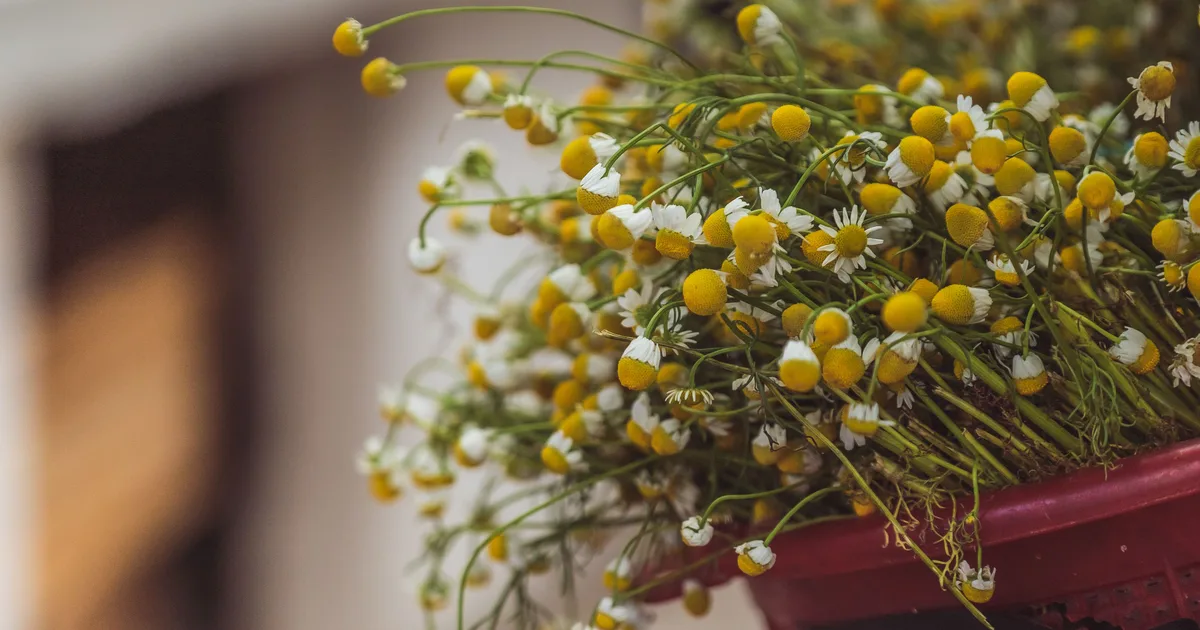
Harvest the flowers when they are near full bloom for the best quality, per UW-Madison Extension. In practice that means the white petals are out flat and the yellow center has opened up but has not started to dome and drop its petals.
Pinch or snip the head off right at its base and leave the green stem on the plant. Stem tissue brings a grassy, astringent edge to the cup that you do not want. Morning picking is the habit worth building, before the day’s heat pulls off the volatile oils.
Keep picking, even if you are not ready to brew. Letting heads mature into seed tells the plant its job is done and production stops. Stripping them regularly pushes new flower stems from further down.
How Do You Dry Chamomile for Tea?
This is where the tea is actually made. The compound most people grow chamomile for is barely present in the living flower.
In fresh chamomile, apigenin is locked up as a sugar-bound form called apigenin-7-O-glucoside. Free apigenin, the form that research links to binding at central benzodiazepine receptors, appears mostly after harvest, as that sugar bond breaks down during drying and storage (Planta Medica). Differences between chamomile samples come down to how they were handled after picking, not how they were grown.
Which makes drying temperature the decision that matters. A 2023 study in Sustainability compared four methods and found the highest polyphenol content and antioxidant activity in the coolest ones.
| Method | Conditions | Result |
|---|---|---|
| Sun | ~30°C, 4 days | Highest polyphenols and antioxidant activity |
| Shade | 20-25°C, 7 days | Close behind sun, best aroma retention |
| Climate chamber | 60°C, 48 hours | Most negative effect on compounds |
| Dryer | 105°C, 24 hours | Significantly reduced polyphenols |
Shade drying is the pick for home growers. Sun-dried flowers scored highest on polyphenols, but the same study found beta-farnesene, an aroma compound, came out significantly lower in them.
A separate 2021 Sustainability study likewise found shade drying best preserved the essential oil profile, with more alpha-bisabolol. Cool and dark gets you both.
Spread the heads in a single layer on a mesh screen with air moving around them. Piling them up traps moisture and invites mold. Give them about a week, then store them in an airtight jar somewhere dark.
You can steep fresh flowers, and it makes a pleasant light, grassy cup. Just know it is a different drink, not a stronger one. The dried version is the one that carries the apigenin.
What Goes Wrong with Hydroponic Chamomile?
Four problems account for most failures, and three of them happen before the plant ever flowers.
Nothing sprouted. The seeds were buried. Surface sow and leave them uncovered, and keep light on the tray from day one.
Tall, floppy stems and no buds. Not enough light, or the photoperiod is too short. Chamomile needs a long day to switch into flowering, so run 16 hours.
Lots of leaf, still no flowers. Nitrogen is too high. Ease it back and raise potassium once the plant is established.
Brown, slimy roots. Root rot, usually from a warm reservoir with weak aeration. Our root rot guide covers the full fix.
Which chamomile should I grow hydroponically?
German chamomile (Matricaria chamomilla). It grows as an upright annual to about 2 feet, which anchors properly in a net cup, and it produces far more flower heads than Roman chamomile, which creeps flat along the ground (UW-Madison Extension).
Why won't my chamomile seeds germinate?
Almost always because they were buried. Chamomile seeds need light to germinate, so they must be surface sown and left uncovered (UW-Madison Extension). Press them onto damp media for contact and never push them into a rockwool dibble hole.
How much light does hydroponic chamomile need?
Less than most flowering crops, which is what makes it practical indoors. A 2025 HortScience vertical farm trial flowered chamomile under LEDs alone at a Daily Light Integral of 17 mol/m2/day, on a 16-hour photoperiod.
How many chamomile plants do I need for regular tea?
More than you would expect, because a flower head weighs very little dried. A single plant gives you a small handful across its whole run, so plan on 6 to 10 plants in rotation if you want a steady supply rather than an occasional cup.
Can I use chamomile fresh instead of drying it?
You can, but it is a different drink. Free apigenin is nearly absent in living flowers and forms after harvest as apigenin-7-O-glucoside breaks down (Planta Medica). Fresh chamomile brews light and grassy, while dried carries the compound the plant is known for.
Grow German, sow on the surface, and dry cool. Those three calls decide almost everything about how your chamomile turns out. Pair it with mint and lemon balm so you have something to drink while the slow crop catches up.
Sources (5)
- University of Wisconsin-Madison Division of Extension, German Chamomile, Matricaria chamomilla, retrieved 2026-07-27, https://hort.extension.wisc.edu/articles/chamomile-matricaria-chamomilla/
- HortScience, Apigenin Accumulation in Matricaria chamomilla and Petroselinum crispum Produced in a Vertical Hydroponic System, 2025, https://journals.ashs.org/view/journals/hortsci/60/1/article-p17.xml
- Sustainability, Effect of Drying Methods on Chemical Profile of Chamomile (Matricaria chamomilla L.) Flowers, 2023, https://www.mdpi.com/2071-1050/15/21/15373
- Sustainability, Differences in the Aroma Profile of Chamomile (Matricaria chamomilla L.) after Different Drying Conditions, 2021, https://www.mdpi.com/2071-1050/13/9/5083
- Planta Medica, On the accumulation of apigenin in chamomile flowers, retrieved 2026-07-27, https://pubmed.ncbi.nlm.nih.gov/17221394/