Fastest-Growing Hydroponic Crops: Days to Harvest Chart
Microgreens harvest in 7 days, leaf lettuce in 20 to 40, tomatoes in 90 to 120. A days-to-harvest table for 19 hydroponic crops, built from extension data.
In this guide
The fastest-growing hydroponic crops are microgreens, ready in about a week. A tomato takes three to four months. Everything else falls between those two poles, and knowing where a crop sits decides whether your system pays you back this month or next season.
The catch is that “days to harvest” means two different things, and most charts don’t say which one they’re quoting. Here’s the full reference, with the starting point spelled out for every crop, plus what actually moves the number.
The short version
- Microgreens are the fastest crop at 7 to 14 days, because they're cut at the seed-leaf stage before they need much light or feeding (Penn State Extension).
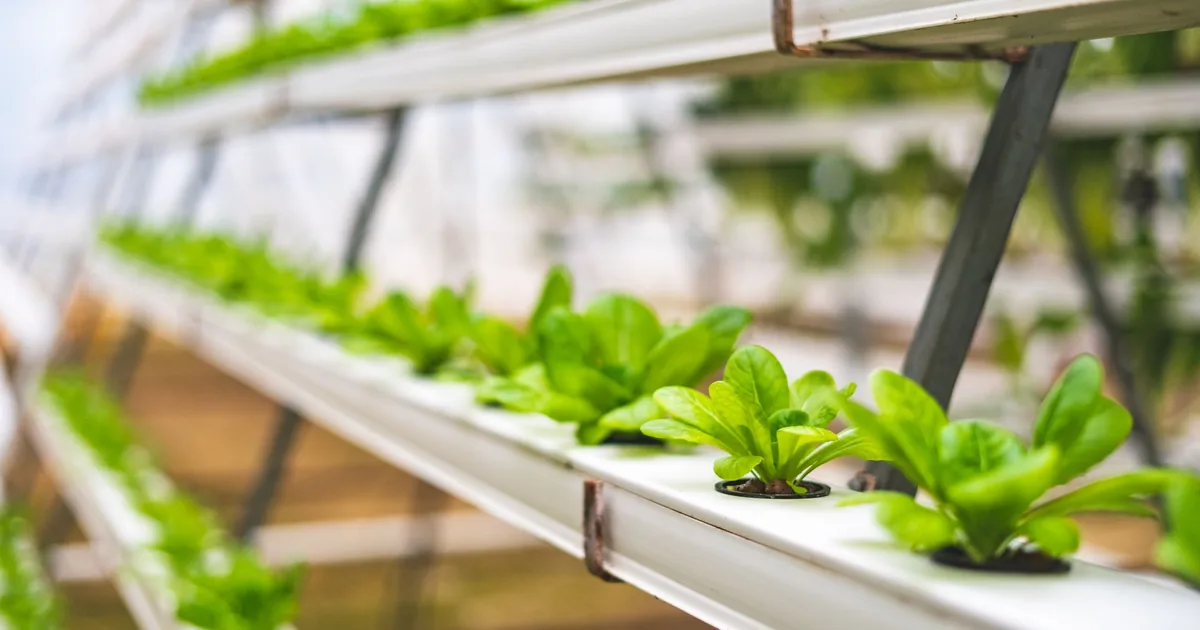
- Leaf lettuce is the fastest full-size crop at 20 to 40 days from seed. Head-forming types take the same time again from transplant (UT Extension).
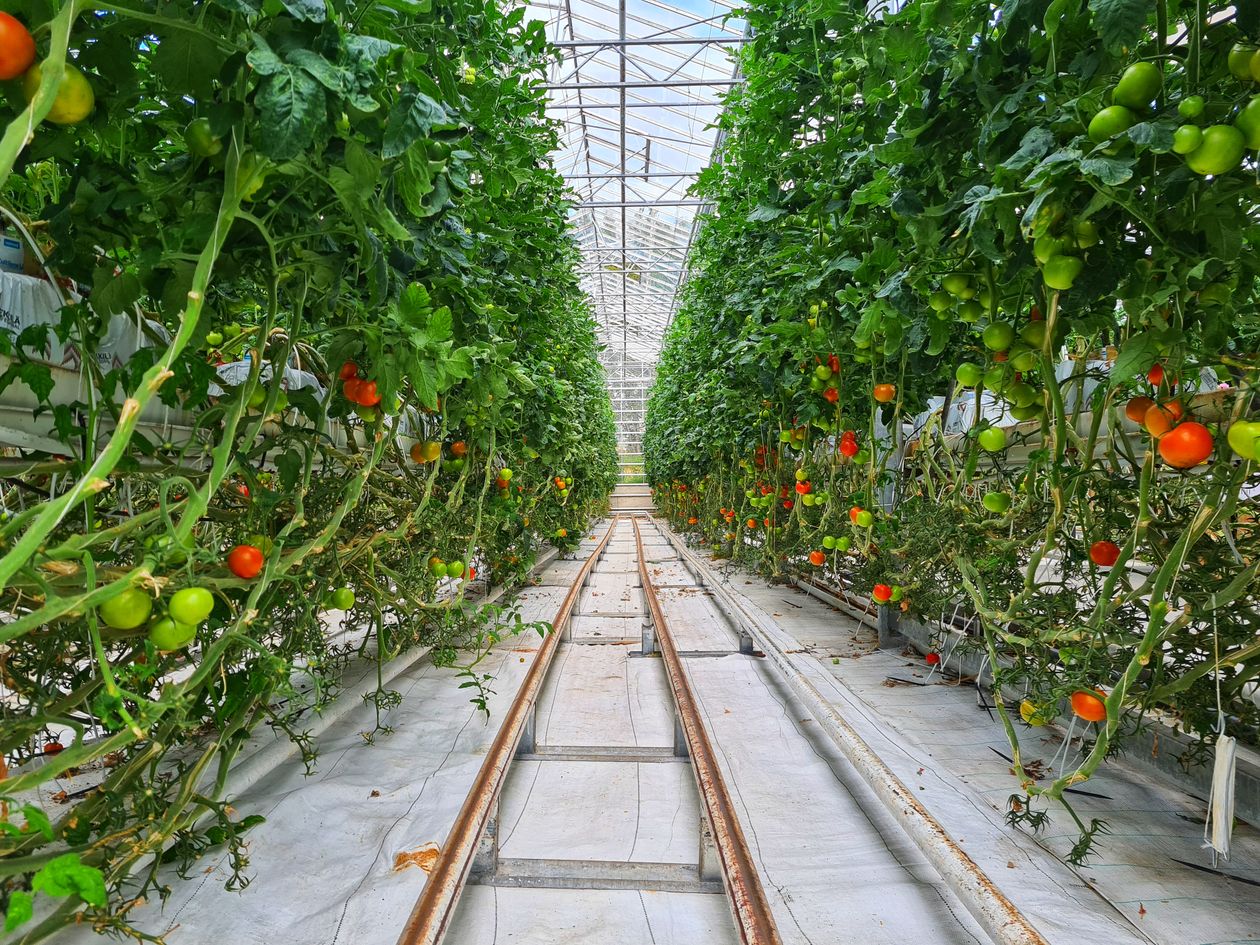
- Fruiting crops are a different category of wait: cucumbers 30 to 50 days, tomatoes 90 to 120 (UT Extension).
- Light and root temperature set the speed. Extra nutrient does not, and past a point it stunts the plant.
What are the fastest-growing hydroponic crops?
Ranked fastest to slowest, by days from sowing unless the row says otherwise.
| Crop | Category | Days to harvest | Counted from | Cut again? |
|---|---|---|---|---|
| Radish microgreens | Microgreen | 7 | Seed | No |
| Arugula microgreens | Microgreen | 9 | Seed | No |
| Red cabbage microgreens | Microgreen | 11 | Seed | No |
| Leaf lettuce | Leafy green | 20-40 | Seed | Yes |
| Pak choi | Leafy green | 20-40 | Seed | Yes |
| Head lettuce | Leafy green | 20-40 | Transplant | No |
| Radish (bulb) | Root crop | 20-45 | Seed | No |
| Mustard, mizuna | Leafy green | 20-50 | Seed | Yes |
| Kale | Leafy green | 20-55 | Seed | Yes |
| Arugula | Leafy green | 25-40 | Seed | Yes |
| Cucumber | Fruiting | 30-50 | Seed | Keeps bearing |
| Spinach | Leafy green | 30-60 | Seed | Yes |
| Swiss chard | Leafy green | 35-55 | Seed | Yes |
| Dill | Herb | 40-50 | Seed | Yes |
| Cilantro | Herb | 50-60 | Seed | Yes |
| Basil | Herb | 60-80 | Seed | Yes |
| Mint | Herb | 70-80 | Transplant | Yes |
| Tomato | Fruiting | 90-120 | Seed | Keeps bearing |
| Pepper | Fruiting | 112-140 | Seed | Keeps bearing |
Microgreen figures are from a 2024 review in Food Chemistry Advances. Fruiting crop figures are from UT Extension's soilless production guide. The remaining rows come from UT Extension's small-space crop tables, which are measured in containers rather than hydroponics. Expect the lower end of each range in a well-run system, where water and nutrients are never the limiting factor.
Two things stand out. Microgreens aren’t just faster than everything else, they’re in a different league, because you’re harvesting a seedling rather than growing a plant. And a pepper takes longer to reach first harvest than four back-to-back lettuce crops.
Days to first harvest, fastest to slowest
Bars show the midpoint of each range, scaled against a 140-day maximum. Fruiting crops are muted because they keep bearing after the first harvest, so the single number understates them.
Why “days to harvest” means two different things
The number on a seed packet counts from one of two starting points, and packets rarely say which. That single ambiguity is where most scheduling errors come from.
- From seed. The whole clock, sowing to cutting. This is what UT Extension uses for leaf crops, radishes, and most herbs.
- From transplant. Starts when the seedling moves into the system, which skips the two to four weeks it spent in a nursery tray or rockwool cube.
The gap is not small. Alabama Extension puts greenhouse lettuce at a 30-day cycle from transplant to harvest, with seedlings going in at about two weeks old. Call it 44 days from seed for the same crop that a chart might advertise as 30.
Fruiting crops split the same way, just over longer spans:
| Crop | Seeding to transplant | Transplant to first harvest |
|---|---|---|
| Cucumber | 2-3 weeks | 4-6 weeks |
| Tomato | 2-4 weeks | 7-10 weeks |
| Pepper | 6-8 weeks | 10-12 weeks |
From UT Extension W844-C. A pepper spends nearly two months in the nursery before it ever reaches your system.
Which crops keep producing after the first cut?
Some crops give you one harvest. Others give you a first cut and then keep going, which changes the arithmetic completely over a season.
Cut-and-come-again works when you leave the growing point intact:
- Leaf lettuce, kale, chard. Take the outer leaves only and leave the central crown undamaged. New leaves push from the middle.
- Basil and branching herbs. Cut just above a pair of leaves. Removing the tip releases the side buds below it, and the plant branches instead of stretching.
- Head lettuce, radishes, microgreens. One and done. Harvesting takes the whole plant.
The regrowth is faster than the first cut because the root system is already built and running at full capacity. The plant skips germination and establishment entirely and puts everything into new leaf. This is why the same approach works for regrowing herbs after harvesting rather than reseeding every cycle.
Practical consequence: if you’re picking a crop for a small system you want producing continuously, a cut-and-come-again green beats a faster single-harvest crop on total food over 90 days.
What actually controls how fast a crop grows?
Four inputs, in order of how much they matter.
1. Light
Daily light integral (DLI) is the total light a plant receives in a day, measured in moles per square meter per day. Michigan State’s targets are 12 or more for leafy greens and herbs, and 15 or more for fruiting vegetables. Below the target, plants stretch, thin out, and take longer. This is the single most common reason a home crop misses its chart timing.
2. Root temperature
In a 2024 lettuce study in Frontiers in Plant Science, raising root-zone temperature 3 degrees C above air temperature increased shoot dry mass by 14 to 31 percent depending on air temperature, with the largest gain at 22 degrees C air. Keep lettuce roots between 64 and 72 degrees F.
3. Nutrient strength, up to a point
Nutrients prevent a deficiency from slowing growth. They do not accelerate a plant that already has enough. Push EC past the crop’s range and osmotic pressure works against the roots, stomata close, and growth stalls. Oklahoma State puts leafy greens around 1.2 to 1.8 mS/cm and UT puts fruiting crops at 2.0 to 3.0. Start with pH and nutrient basics before touching anything else.
4. Spacing
In 2024, an Arizona State trial grew lettuce at 21, 42, and 81 plants per square meter for 24 days. At the highest density individual plants lost up to 45 percent of their shoot weight, but total yield per square meter rose from 1.6 to 4.1 kg. Crowd for total output, space out for big individual heads.
Targets by crop group
| Crop group | DLI (mol/m2/day) | EC (mS/cm) | pH |
|---|---|---|---|
| Leafy greens and herbs | 12+ | 1.2-1.8 | 5.6-6.0 |
| Fruiting crops | 15+ | 2.0-3.0 | 5.5-6.0 |
Which fast crop should you start with?
- Fastest result, least gear: radish microgreens. Seven days, a tray, and a bright windowsill. No pump, no nutrients.
- Fastest real vegetable: leaf lettuce. It also matches the water use of a passive Kratky jar almost perfectly, so you can run it without electricity.
- Fastest herb: dill at 40 to 50 days, well ahead of basil’s 60 to 80.
- Fastest fruiting crop: cucumber. First harvest in 30 to 50 days, versus three months or more for a tomato.
If you’re still deciding what belongs in your system rather than how long it takes, start with which crops suit a beginner build.
Frequently Asked Questions
What is the fastest growing hydroponic plant?
Microgreens. Radish microgreens are ready 7 days after sowing, arugula at 9 days, and red cabbage at 11 days. They’re cut at the cotyledon stage, so the crop runs almost entirely on energy stored in the seed rather than on light and nutrients you have to supply.
What is the fastest full-size vegetable in hydroponics?
Leaf lettuce, at 20 to 40 days from seed. Nothing about a leaf lettuce needs to form a head or set fruit, so every day of growth goes straight into edible leaf. Arugula follows closely at 25 to 40 days.
How fast do hydroponic tomatoes grow?
Roughly 90 to 120 days before the first fruit ripens. That splits into 2 to 4 weeks from seeding to transplant, then 7 to 10 weeks from transplant to first harvest. After that a healthy plant keeps bearing for months. Full detail in the hydroponic tomatoes guide.
Is the days-to-harvest number on a seed packet accurate for hydroponics?
Not directly. Packet figures are written for garden beds, and depending on the crop they count from either sowing or transplanting. Check which baseline your packet uses before you plan a schedule, because the two differ by two to four weeks for most crops.
Can you make a hydroponic crop grow faster?
Light and temperature are the two levers that work. Leafy greens and herbs want a daily light integral of at least 12 mol per square meter per day, and lettuce roots do best between 64 and 72 degrees F. Adding more nutrient than the crop needs does not speed anything up and usually slows it down.
Sources (9)
- Bumgarner, N., Dunlap, A., Treadway, H., “Crops and Cultivars for Small-Space Food Production,” University of Tennessee Extension W1288-C, retrieved 2026-07-19, https://uthort.tennessee.edu/wp-content/uploads/sites/228/2025/04/W1288C-Small-Space-Cultivars.pdf
- Bumgarner, N., “Tomatoes, Peppers and Cucumbers in Small-Scale Soilless and Hydroponics Systems,” University of Tennessee Extension W844-C, retrieved 2026-07-19, https://rutherford.tennessee.edu/wp-content/uploads/sites/200/2022/05/W844-C-Tomatoes-Peppers-and-Cucumbers-in-Small-Scale-Soilless-and-Hydroponics-Systems.pdf
- Alabama Cooperative Extension System, “Greenhouse Lettuce Production,” retrieved 2026-07-19, https://www.aces.edu/blog/topics/crop-production/greenhouse-lettuce-production/
- Penn State Extension, “Growing Microgreens,” retrieved 2026-07-19, https://extension.psu.edu/growing-microgreens
- “Emergence of microgreens as a valuable food, current understanding of their market and consumer perception: A review,” Food Chemistry Advances, 2024, PMC11225695, retrieved 2026-07-19, https://pmc.ncbi.nlm.nih.gov/articles/PMC11225695/
- Runkle, E., “DLI ‘Requirements’,” Michigan State University Department of Horticulture, retrieved 2026-07-19, https://www.canr.msu.edu/floriculture/uploads/files/dli%20requirements.pdf
- “Raising root zone temperature improves plant productivity and metabolites in hydroponic lettuce production,” Frontiers in Plant Science, 2024, retrieved 2026-07-19, https://www.frontiersin.org/journals/plant-science/articles/10.3389/fpls.2024.1352331/full
- Barnett, N., Park, Y., “Optimizing Planting Density to Maximize Yield in Hydroponic Lettuce Production,” Arizona State University College of Integrative Sciences and Arts, retrieved 2026-07-19, https://cisa.asu.edu/sites/g/files/litvpz691/files/2024-12/Barnett_N_Park%20Student%20Showcase%20Fall%202024.pdf
- Oklahoma State University Extension, “Electrical Conductivity and pH Guide for Hydroponics,” HLA-6722, retrieved 2026-07-19, https://extension.okstate.edu/fact-sheets/electrical-conductivity-and-ph-guide-for-hydroponics