IKEA Hack Hydroponics: What Actually Works (and What Doesn't)
IKEA hydroponic hacks cost $15 to $35. We broke down SAMLA boxes, EKRAR racks, and KRYDDA kits to find out what actually grows plants and what always fails.
In this guide
IKEA hydroponic hacks look incredible on Pinterest. Clean white bins, green leaves spilling over the edges, lettuce growing in what used to be a storage box. But those photos almost never show what happened three weeks later: the algae bloom, the wet floor, or the rack that bent under two liters of water.
We pulled apart the most popular IKEA builds to find which ones actually grow healthy plants, and which ones are built for the photo, not the harvest.
Some links in this article may be affiliate links. We earn a small commission if you purchase through them, at no extra cost to you.
The short version
- SAMLA storage boxes work as hydroponic reservoirs once you black them out. IKEA officially rates them as not food-safe, so food-grade containers are the cleaner long-term choice for edible crops.
- IKEA's purpose-built KRYDDA/VÄXER kit was designed with agricultural scientists and worked well. It was discontinued around 2020 and is now hard to source.
- Vertical hacks using the EKRAR coat stand fail structurally. Three 3-liter reservoirs can push past the rack's safe load limit, causing tipping and leaks.
- Based on June 2026 IKEA US pricing, a SAMLA or TROFAST DIY build costs $15 to $35. Most commercial countertop smart gardens start at $100 to $150.
Why Do People Use IKEA for Hydroponics?
The main driver is cost. Commercial indoor growing kits carry big markups, and IKEA products are cheap, globally available, and easy to modify with basic hand tools, making hydroponics for beginners much more accessible (UMN Extension, 2023). You can find a SAMLA box in almost any city, which matters when you need to replace a cracked lid or add a second reservoir.
There’s also a credibility factor. IKEA actually invested in hydroponics research, developing the KRYDDA/VÄXER kit with Swedish agricultural scientists to give home growers a science-backed system. That history lends the whole IKEA-hydro concept more weight than a random storage bin.
The real appeal, though, is volume. Most commercial starter kits near $100 come with reservoirs under 4 liters. That tiny buffer forces daily pH checks and constant top-offs. A 22-liter SAMLA box for under $10 gives you far more stability with the same basic concept.
Are SAMLA Boxes Good for Hydroponics?
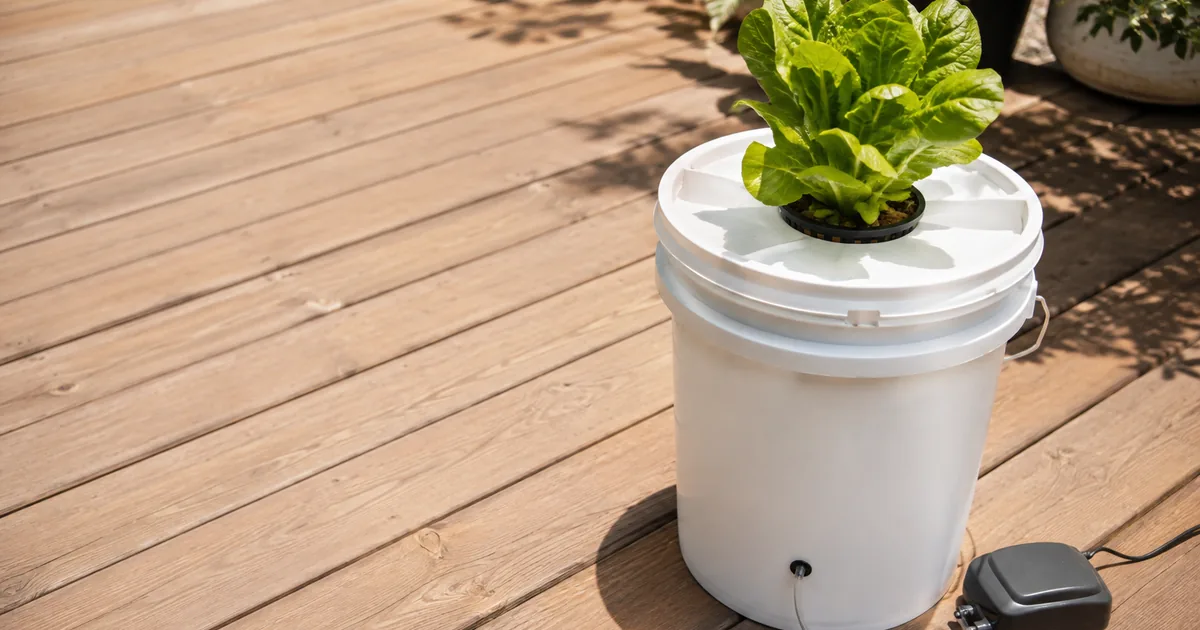
SAMLA boxes are the most widely used IKEA hydroponic hack, and they earn it. Made from polypropylene (PP), they’re tough, easy to drill, and hold water without warping (IKEA product page). The 22-liter and 45-liter sizes work well as deep water culture reservoirs or for the Kratky method. Drill 2-inch holes in the lid for net pots, fill with nutrient solution, and you’re growing.
There’s one problem you must fix first: algae.
SAMLA bins are transparent. Under grow lights, green algae can colonize a clear nutrient reservoir within days, competing with your plants for dissolved oxygen and nutrients, with root rot close behind. The fix costs almost nothing: spray the exterior with a dark primer, then a white reflective topcoat. Roughly $5 and 20 minutes of work.
The second issue is food safety. IKEA explicitly states the SAMLA is “not approved for food contact.” Over multiple crop cycles, non-food-grade plastic can leach trace compounds into nutrient solution, particularly under acidic pH (5.5 to 6.5) and warm LED heat (PMC review on microplastic uptake in plants, 2021). For ornamental grows it’s a non-issue. For herbs and leafy greens you’re eating, a food-grade container is the safer long-term call.
Most IKEA hydro guides skip the food safety point entirely because it complicates the “it just works” framing. But IKEA publishes it right on the product page. It’s not a reason to abandon SAMLA, just a reason to know what you’re working with.
KRYDDA/VÄXER: IKEA’s Official Hydroponic Kit
In 2016, IKEA launched the KRYDDA/VÄXER series as a dedicated countertop hydroponic system developed with Swedish agricultural scientists, specifically to simplify growing for home growers and apartment dwellers. The system used stone wool plugs for germination and pumice stones for root support, cutting out the need to manage a traditional nutrient reservoir from day one.
It worked well. The problem: IKEA discontinued it globally around 2020. Replacement stone wool inserts and the linear LED grow light strips are now difficult to source. The LED units also ran at relatively low intensity, fine for basil and lettuce but not adequate for fruiting crops like tomatoes or chilies. IKEA has since released the NYSÄTTRA countertop unit as a simplified follow-up, though it functions more like a plug-and-play smart garden than a modular system.
If you want IKEA’s current hydroponics offering, NYSÄTTRA is it. If you want more volume and flexibility, the DIY SAMLA or TROFAST route delivers both at a lower cost.
Why Do IKEA Vertical Rack Hacks Fail?
Vertical hanging hacks using the EKRAR hat and coat stand appear constantly on Pinterest, and the appeal is obvious: a white metal frame, rows of hanging planters, greenery cascading down the side of an apartment wall. In practice, the structure fails under the weight of water.
The EKRAR is designed for coats, not water. The stand carries a defined maximum structural load per IKEA’s product specifications (IKEA). Three 3-liter water-filled reservoirs can push past that limit on their own before you’ve added clay pebbles, net pots, or any plant biomass. Real builds report the joints snapping, screws stripping, and systems tipping mid-grow.
Drainage is the second failure point. Hanging planters without purpose-built bulkhead fittings drip continuously. Without sealed drain connections, nutrient solution pools on the floor and damages anything below it.
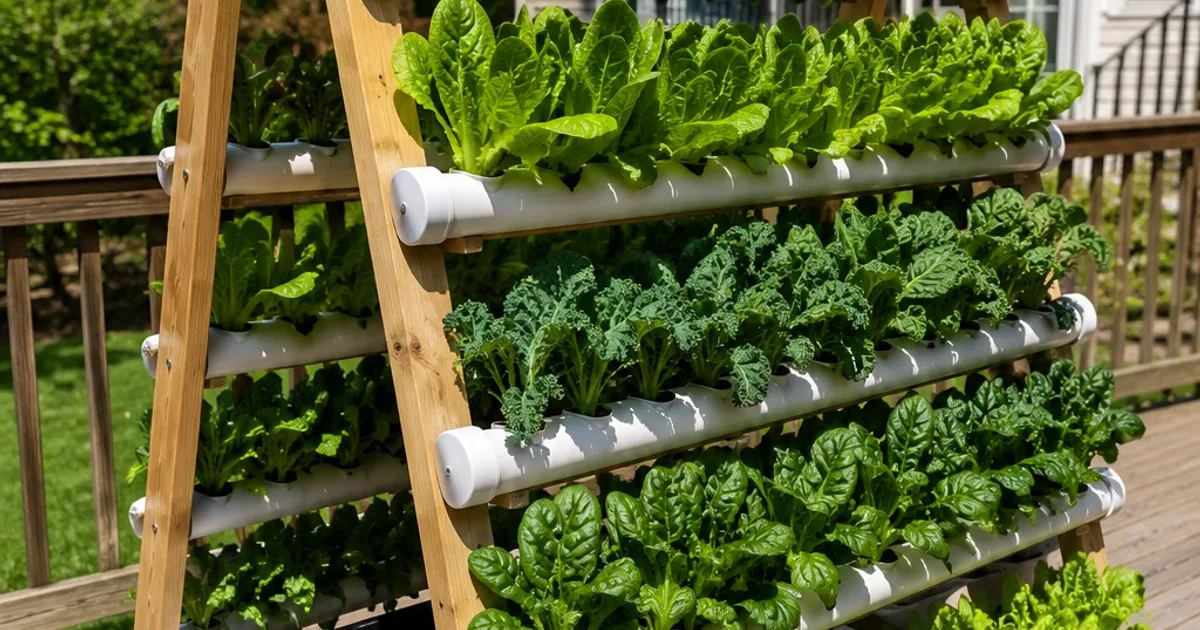
If you want a vertical grow, build for the water load, not around whatever rack you already own. Purpose-built PVC frames, like the one in our $20 PVC Kratky wall build, handle both load and drainage because they’re designed from the start to hold water.
Other Containers Worth Knowing
Two other IKEA products perform better than most guides acknowledge.
KUGGIS bins are opaque white, which blocks light naturally (IKEA US). No painting needed. The drawback is a pre-molded handle cutout on the side that limits how high you can fill the reservoir. Overfill past that opening and nutrient solution leaks through it. Stick to small desktop herb builds and keep the fluid level conservative.
TROFAST play boxes are thick polypropylene with flanged rims designed to slide into frames (IKEA US), making them ideal for multi-tier ebb-and-flow setups. An intermediate builder can nest a shallow TROFAST inside a deeper one for a self-contained DWC system. More complex to build ($30 to $50, 3 to 5 hours) but genuinely scalable.
How Do the Costs Compare?
Based on June 2026 IKEA US pricing, a basic SAMLA DWC build (box, lid, net pots, clay pebbles) costs roughly $15 to $25. A TROFAST ebb-and-flow setup runs $30 to $50. A KUGGIS desktop build sits around $18. Commercial countertop smart gardens start at $100 to $150 and offer smaller reservoirs with integrated lighting. That price gap is genuine: a SAMLA’s 22-liter reservoir gives you nearly six times the solution volume of a typical commercial 4-liter kit, which means fewer top-offs and more stable pH between checks.
The savings are real. But they’re not unlimited: you still need a separate grow light ($30 to $80 for a usable LED panel), nutrients, and pH tools. Factor those in before comparing against an all-in-one kit.
Estimated build cost: IKEA hacks vs. commercial smart garden kit (excluding grow lights)
Estimates based on IKEA US pricing, June 2026. Excludes grow light, nutrients, pH tools, and air pump where required.
| Container | Cost (excl. light) | Light-Blocking | Key Limitation |
|---|---|---|---|
| SAMLA 22L | ~$20 | No, must paint exterior | Not rated food-safe by IKEA |
| KUGGIS | ~$18 | Yes, opaque white | Low fill height from handle cutout |
| TROFAST boxes | ~$30–$50 | Yes, opaque | Needs a frame; 3–5 hrs to build |
| Commercial smart garden | ~$120 | N/A | Smallest reservoirs (under 4L) |
Should You Build an IKEA Hydroponic Hack?
A 2025 South Dakota State University Extension guide on small-scale hydroponic production confirms these systems are genuinely viable for home growers (SDSU Extension). The IKEA versions add a cost advantage: based on June 2026 pricing, a SAMLA or TROFAST build runs $15 to $35 versus $100 to $150 for a commercial kit.
The rules are simple. Use SAMLA with a blackout treatment and keep food safety in mind for edible crops. Use TROFAST if you want to scale to multiple tiers. Skip the EKRAR and any vertical furniture hack that isn’t designed to carry water weight.
- SAMLA and TROFAST: buy them, modify them, grow in them.
- KRYDDA/VÄXER: great concept, now discontinued. Look for NYSÄTTRA instead.
- EKRAR and vertical furniture hacks: skip entirely.
Want a DIY wall build that handles the load from the start? Our $20 PVC Kratky wall guide covers the full build for 20 plants on about $20 worth of materials.
Is the IKEA KRYDDA/VÄXER kit good for beginners?
The KRYDDA/VÄXER was designed with agricultural scientists to make hydroponics beginner-friendly. The catch: IKEA discontinued it globally around 2020, so replacement stone wool inserts and LED fixtures are now hard to source. The newer NYSÄTTRA countertop unit is the closest current substitute.
Can you use any IKEA storage box for hydroponics?
Structurally, most work fine. But IKEA officially labels SAMLA boxes as not approved for food contact. Clear bins like SAMLA also need a full blackout treatment to stop algae. Opaque options like KUGGIS skip that step but have lower reservoir volume.
How much does an IKEA hydroponic hack cost compared to a store-bought kit?
A basic SAMLA or TROFAST build runs $15 to $35 excluding grow lights. Most commercial countertop smart gardens start at $100 to $150. The gap is real, but you still need to buy a grow light, nutrients, and net pots separately.
Do IKEA hydroponic hacks need extra equipment?
For a passive Kratky setup in a SAMLA box, no pump is needed. Just maintain an air gap beneath the net pots. For deep water culture or a TROFAST ebb-and-flow build, you’ll need a submersible pump and air stone. Factor that cost in before comparing against an all-in-one kit.
Sources (6)
- University of Minnesota Extension, “Small-Scale Hydroponics,” retrieved 2026-06-18, https://extension.umn.edu/how/small-scale-hydroponics
- IKEA US, “SAMLA box with lid, clear, 15¼x11x5½”/3 gallon, product page,” retrieved 2026-06-18, https://www.ikea.com/us/en/p/samla-box-with-lid-clear-s69440836/
- IKEA US, “EKRAR hat and coat stand, white, product page,” retrieved 2026-06-18, https://www.ikea.com/us/en/p/ekrar-hat-and-coat-stand-white-10415594/
- PMC / National Library of Medicine, “Uptake and Accumulation of Nano/Microplastics in Plants: A Critical Review,” 2021, https://pmc.ncbi.nlm.nih.gov/articles/PMC8618759/
- South Dakota State University Extension, “Harvesting the Future: Your Guide to Growing Fresh, Year-Round Produce with Small-scale Hydroponic Production Systems,” June 2025, https://extension.sdstate.edu/sites/default/files/2025-06/P-00337.pdf
- Oklahoma State University Extension, “Building a Vertical Hydroponic Tower,” retrieved 2026-06-18, https://extension.okstate.edu/fact-sheets/building-a-vertical-hydroponic-tower