Grow an Indoor Bedtime Tea Blend, Seed to Cup
Chamomile, lavender and lemon balm grow on one indoor shelf. Dry, blend and store all three herbs into a homemade bedtime tea blend that keeps about a year.

In this guide
- What Goes Into a Bedtime Blend, and How Much?
- Do You Need to Grow All Three Yourself?
- How Do You Dry Three Herbs So They’re Ready the Same Day?
- How Do You Blend Them?
- How Do You Store the Blend So It Stays Fresh?
- How Do You Brew the Blend?
- How Do You Turn It Into a Routine, Not Just a Recipe?
- Frequently Asked Questions
Chamomile, lavender and lemon balm already each have a full grow guide on this site, and each one fits on a single indoor shelf. None of them cover what happens after the third harvest. That is the part this guide handles: drying three herbs to the same dryness, how much of each goes in the jar, and how to keep the finished blend from going flat.
This article picks up right there. No growing tutorial repeated, just the drying, blending, storing and steeping steps that turn three separate harvests into one finished bedtime tea blend.
The short version
- Chamomile, lavender and lemon balm mature on three different schedules, so most growers start blending before all three are ready at once.
- Dry each herb completely and separately first. A still-damp herb mixed into a jar of dry ones risks mold in the whole batch (UC ANR Master Food Preserver).
- Blend by weight, not volume. Flower heads and leaf pieces pack a measuring spoon very differently.
- Store it airtight, dark and cool. Kept that way, a dried herb blend holds its flavor for about a year.
- Steep just off the boil for about five minutes, then taste before you call it done.
What Goes Into a Bedtime Blend, and How Much?
A bedtime blend is three herbs, each doing a different job: chamomile for the base, lemon balm for brightness, and lavender for a floral accent. Bedtime tea just names when you drink it, the same way breakfast tea names a time of day rather than a specific effect. Together, they read as one cup instead of three separate flavors competing with each other.
| Herb | Part You Use | Flavor Role |
|---|---|---|
| German chamomile | Flower heads | Sweet, mellow base |
| Lemon balm | Leaves | Bright, citrusy top note |
| Lavender | Flower buds | Floral accent, used sparingly |
Valerian, passionflower and skullcap show up in a lot of other evening tea recipes, but none of them make it into this one. Valerian has a strong, musty smell that overwhelms everything else in the jar. Passionflower and skullcap both bring a heavy bitterness that fights the citrus and floral notes already here.
Do You Need to Grow All Three Yourself?
No. Start the jar with whichever herb is ready first, and fill in the rest with store-bought dried herbs until your own plants catch up.
The three don’t mature on the same schedule, since they don’t even start the same way:
| Herb | How It’s Started | Time to First Harvest |
|---|---|---|
| Lemon balm | Seed | 4 to 6 weeks |
| Chamomile | Seed, sown on the surface | 8 to 10 weeks |
| Lavender | A cutting, rooted in about 3 weeks first | 10 to 12 weeks after that |
Lemon balm and chamomile are usually producing well before a lavender cutting has even finished rooting. Flavor tends to peak right around the point each plant starts to flower, which lines up with when each grow guide already tells you to start picking. The full growing steps live in the full chamomile grow guide, how to root and grow lavender, and growing lemon balm from seed, so none of that gets repeated here.
How Do You Dry Three Herbs So They’re Ready the Same Day?
Dry each herb completely and separately before they ever touch each other. One slightly damp batch can mold a whole jar, not just its own corner. Good airflow while drying matters as much as the drying itself.
Most herbs are ready by feel, not by the calendar: they crumble and the stems snap instead of bending when you try to fold them. Air drying takes about five to ten days for most herbs. A dehydrator gets there faster, running at 95 to 115 degrees Fahrenheit for one to four hours instead of days.
Lemon balm is the one to watch most closely. Its leaves hold more moisture than a chamomile flower head or a lavender bud. That makes it the one most likely to mold if you rush it or crowd it into a still, damp room. Give it real airflow, not just a closed cabinet.
If any piece still bends instead of snapping, or feels cool and a little soft rather than crisp, it isn't ready. Give it more time before it goes anywhere near the blending bowl, since one damp piece is enough to risk the whole jar.
Keep one labeled jar per herb while you’re waiting on all three. Top each jar up across several harvests until there’s enough of every herb to blend, rather than trying to time one big harvest of all three at once. Regular cutting doesn’t hurt the plants either, since keeping the plant producing after each cut is exactly how a single lemon balm plant keeps a jar topped up all season.
How Do You Blend Them?
Measure by weight, not by the spoonful. A tablespoon of dense lavender buds weighs a lot more than a tablespoon of light, papery chamomile petals, so eyeballing it with a measuring spoon throws the balance off fast.
A good place to start: roughly half chamomile by weight, with lemon balm and lavender splitting the rest and lavender as the smaller share. Treat that as a starting point, not a rule, and adjust the next jar based on what you liked. Lavender especially can turn soapy-tasting if you lean on it too heavily.
- Rub the lavender buds gently between your palms. This opens them up without grinding them to dust.
- Crumble the lemon balm leaves into rough flakes. Keep the pieces coarse rather than fine.
- Leave the chamomile heads whole. They hold their flavor better intact than crushed.
- Weigh each herb and combine them in a bowl. Toss gently until they look evenly mixed.
- Jar the blend right away. Every minute it sits out in kitchen air is a minute it can pull in moisture.
How Do You Store the Blend So It Stays Fresh?
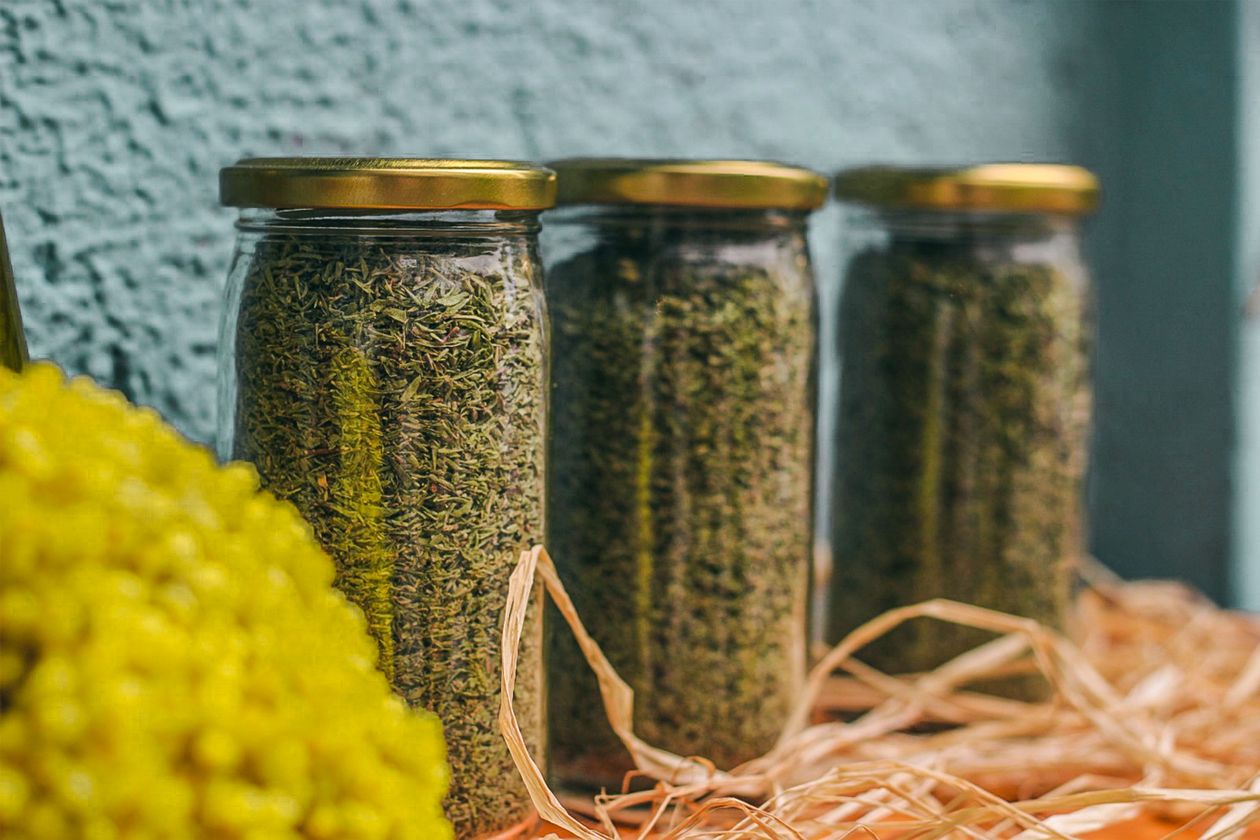
Airtight, dark and cool. Light and air are what flatten a dried blend’s flavor over time, not the calendar by itself.
| Glass jar, tight lid | Metal or wood tin | Cloth drawstring bag | |
|---|---|---|---|
| Blocks light | Only in a cupboard | Yes, fully | No |
| Blocks air and moisture | Yes, with a good seal | Yes | No, breathable fabric |
| Best use | Everyday jar | Gifting, countertop | Steeping one cup, not storage |
A sealed glass jar or a metal tea tin does the job. Keep it in a cupboard, not out on a sunny counter. Stored that way, most dried herbs hold their color and flavor well for about a year. After that, they aren’t unsafe, they just stop tasting like much, which is your cue to start a fresh batch.
Color fades right alongside flavor. A blend that’s gone from deep gold and violet to a dull, faded brown is telling you the same thing a flat smell already told you.
Working out the container cost is part of the same math as figuring out whether a small-space herb shelf pays for itself in the first place.
How Do You Brew the Blend?
A blend of flower heads and leaves doesn’t steep like a single herb, since the two release flavor at different rates. Water just off the boil, about five minutes, then taste, is the starting point worth using until you know your own cup.
Boil the water, then let it sit off the heat for half a minute. Pour it over the blend and cover the cup while it steeps. Covering it keeps the aroma in the cup instead of drifting off as steam. A large mesh basket or a French press gives the flower heads and leaf pieces room to unfurl, which works better than packing everything into a small, cramped tea ball.
Treat five minutes as a guide, not a deadline. A cup brewed a little longer isn’t ruined, it’s just stronger, and that’s a matter of taste rather than a rule to follow exactly.
How Do You Turn It Into a Routine, Not Just a Recipe?
Treat the jar the way you’d treat any other kitchen staple: measured, labeled, and refilled on a schedule. Plenty of growers keep the blend jar for the last cup of the evening, the same way a pot of coffee marks the start of a morning.
The ratio is also a place to play. A lighter jar that leans on lemon balm suits warmer months, while a heavier, more floral jar that leans on lavender suits winter. Either is a flavor choice, not a different recipe.
Small batches also make easy gifts. Split a finished jar into a few small tins. Label each one with the blend and the date you jarred it, then hand them out instead of buying tea. A strip of masking tape and a pen is really all the labeling this needs, nothing fancier.
Frequently Asked Questions
Do you need a garden to grow a bedtime tea blend?
No. Chamomile, lavender and lemon balm all grow on a single indoor shelf or under a small grow light, and each one already has its own full indoor grow guide on this site. The garden was never the limiting factor, the drying and blending afterward is.
What's the ratio of chamomile to lavender and lemon balm?
A good place to start is roughly half chamomile by weight, with lemon balm and lavender splitting the rest and lavender as the smaller share. Treat that as a starting point and adjust the next batch based on what you liked, since lavender can turn soapy-tasting if you lean on it too heavily.
Can you blend the herbs fresh, or do they need to be dried first?
They need to be dried first, and dried separately. A fresh, still-moist herb mixed into a jar of dry ones can bring mold into the whole batch, so every herb should pass the crumble test on its own before it goes near the blending bowl.
How long does a homemade herbal tea blend stay good?
About a year, if it’s kept in a sealed container somewhere dark and cool. Heat, light and air are what flatten the flavor over time, so a jar left out on a sunny counter fades well before that year is up.
Can you mix in store-bought dried herbs with what you grow?
Yes. Lemon balm and chamomile are usually ready well before a lavender plant is, so filling the gap with store-bought dried lavender until your own plant catches up is a normal way to start the jar early.
What's different about brewing a blend versus steeping one herb at a time?
A blend mixes flower heads and leaves, and the two don’t release flavor at the same rate, so the timing runs a little different from steeping any one of the three alone. Water just off the boil, about five minutes, then taste, is a solid starting point before you adjust it to your own cup.
A bedtime blend is really just three herbs grown on staggered schedules, dried the same careful way, and combined by weight instead of guesswork. None of that needs a yard, a dehydrator, or a single claim about what the tea does once it’s in the cup.
- Chamomile as the base, lemon balm for brightness, lavender as the accent, used sparingly.
- Dry each herb completely and separately. The crumble test beats guessing every time.
- Blend by weight. Start around half chamomile, then adjust the next jar from there.
- Store it airtight, dark and cool, and expect about a year of good flavor.
- Water just off the boil, about five minutes, then taste.
A full shelf of homegrown tea is one piece of a bigger small-space setup. If you’re building out the rest of it, quail fit where chickens don’t, and bokashi handles the kitchen scraps that are left over.
Sources (2)
- University of California Agriculture and Natural Resources, Master Food Preserver Program SLO/SB Counties, Preserving Your Harvest: Herbs, retrieved 2026-08-30, https://ucanr.edu/blog/master-food-preserver-slo-sb-counties/article/preserving-herbs
- UF/IFAS Gardening Solutions, Preserving Herbs and Spices, retrieved 2026-08-30, https://gardeningsolutions.ifas.ufl.edu/plants/edibles/vegetables/preserving-herbs-and-spices/


