7 Best Savory High-Protein Breakfasts That Keep You Full
Seven savory high-protein breakfasts with hydroponic herbs. Built around eggs, cottage cheese, and salmon to hit the 35g satiety threshold. See all 7 ideas.
In this guide
- Why Savory Protein Outperforms Sweet at Breakfast
- 1. Chive Cottage Cheese Bowl with Soft-Boiled Egg
- 2. Basil Smoked Salmon Egg Scramble
- 3. Dill and Lemon Salmon Cottage Cheese Bowl
- 4. Three-Herb Baked Eggs (Basil, Chives, Dill)
- 5. Savory Salmon Avocado Halves with Dill
- 6. Basil Smoked Salmon Frittata
- 7. Chive Cottage Cheese Savory Pancakes
- Protein Per Serving: How the Ingredients Stack Up
- Which One Should You Start With?
Sweet breakfasts feel good for about an hour. Then the crash hits and you’re hunting for a snack before 10am.
High-protein savory breakfasts work differently, not because of willpower, but because of hormones. Research shows you need at least 35 grams of protein to trigger a meaningful satiety response: elevated GLP-1, PYY, and CCK, plus a sharp drop in ghrelin. Below that threshold, you get minor appetite modulation. At 35g and above, you’re changing how your body signals hunger for hours afterward (Leidy et al., American Journal of Clinical Nutrition, 2015).
These 7 ideas are built around three proteins research consistently supports: eggs, cottage cheese, and smoked salmon. Each one features hydroponic herbs (basil, chives, or dill) that do real nutritional work beyond flavor.
The short version
- You need 35g+ protein at breakfast to trigger GLP-1, PYY, and CCK and suppress ghrelin meaningfully (Leidy et al., 2015).
- Cottage cheese casein releases amino acids for up to 7 hours, far longer than whey or egg protein alone.
- Chives contain 58.1mg Vitamin C per 100g, which overcomes calcium's block on iron absorption from dairy and eggs.
- Add basil and dill fresh after cooking: heat destroys the eugenol and carvone that make them functionally useful.
Why Savory Protein Outperforms Sweet at Breakfast
The science here goes beyond macros. A 2015 study using fMRI found that eating a high-protein breakfast significantly reduced activation in the amygdala, hippocampus, and midfrontal cortex in response to food images before dinner (Leidy et al., AJCN). That translated directly into fewer evening cravings and less snacking on high-fat foods. Lower protein intakes modified subjective hunger only slightly. Only at 35g and above do circulating hormone levels shift enough to change actual eating behavior.
The recipes below are designed around reaching that number by combining sources, not by eating huge portions of any single food.
Want sweet instead of savory? See our make-ahead high-protein breakfasts for freezer-friendly options.
1. Chive Cottage Cheese Bowl with Soft-Boiled Egg
Best for: All-morning satiety with zero cooking time
Cottage cheese’s satiety advantage comes from its protein structure, not just its macros. It’s roughly 80% casein, which coagulates into a slow-digesting gel in your stomach when exposed to gastric acid. Whey protein peaks in your bloodstream within 60 to 90 minutes. A 1997 study found casein delivers a steady stream of amino acids for up to 7 hours (Boirie et al., PNAS). One cup gives you about 25g of protein.
Add a soft-boiled egg and you clear the 35g threshold. The egg contributes 6.3g of complete protein with a perfect 1.0 PDCAAS score, plus 146.9mg of choline (27% DV) from the yolk (choline is the precursor to acetylcholine, the neurotransmitter behind memory and muscle control). Scatter 2 tablespoons of fresh chives on top: a 12g serving provides 21% of your daily Vitamin K1 and enough Vitamin C to improve iron absorption from the dairy itself.
What’s in it: 1 cup low-fat cottage cheese, 1 soft-boiled egg, 2 tbsp fresh hydroponic chives, black pepper, lemon zest.
Season the cottage cheese first and let it sit 5 minutes before adding the egg. The whey that pools at the bottom concentrates the flavor, so you need far less salt.
2. Basil Smoked Salmon Egg Scramble
Best for: Omega-3 brain support plus anti-inflammatory herb benefit
Three eggs plus 2 ounces of smoked salmon lands around 31g of protein. Fold in a tablespoon of cottage cheese and you’re over 35g. But smoked salmon brings more than protein. A 6-ounce cooked serving of wild sockeye delivers approximately 2,100mg of EPA and DHA omega-3 fatty acids. A 2005 study found each 0.1g daily increment of EPA or DHA is linked to an 8% to 9.9% lower risk of cognitive decline (Morris et al., Archives of Neurology).
Fresh basil added after cooking provides eugenol. At concentrations of 10 to 15 micromolar, eugenol suppresses NF-kB signaling and blocks COX-2 transcription: two of the main molecular drivers of chronic low-grade inflammation. Heat degrades eugenol rapidly, so scatter the basil leaves over the plated eggs, not into the pan.
What’s in it: 3 large eggs, 2 oz smoked salmon (added cold after plating), 1 tbsp cottage cheese, 1 tbsp butter, 10 fresh basil leaves, cracked black pepper.
Per USDA FoodData Central, a 28g (1 oz) serving of smoked chinook salmon contains 33 kcal, 5.2g protein, and 0.149g total omega-3 fatty acids. At 2 ounces in this recipe, you get roughly 300mg of active EPA and DHA without needing a supplement.
3. Dill and Lemon Salmon Cottage Cheese Bowl
Best for: Maximizing iron absorption from your morning meal
This combination targets an iron absorption mechanism most breakfast articles ignore entirely. Non-heme iron (found in eggs, cottage cheese, and herbs) is poorly absorbed on its own, and calcium in dairy actively blocks its uptake at the intestinal wall. The fix is Vitamin C.
A squeeze of lemon juice plus fresh chives (58.1mg Vitamin C per 100g) forms a soluble chelate with ferric iron in the stomach, keeping it absorbable even in the presence of calcium. The enhancing effect is log-dose: more Vitamin C means more iron absorbed. Fresh dill finishes the bowl with quercetin and kaempferol, two flavonoids that activate the NRF2 antioxidant pathway, triggering your body’s production of superoxide dismutase and glutathione peroxidase.
What’s in it: 1 cup cottage cheese, 3 oz smoked salmon, 2 tbsp fresh dill, 1 tbsp fresh chives, juice of half a lemon, cracked black pepper.
4. Three-Herb Baked Eggs (Basil, Chives, Dill)
Best for: Maximum phytochemical load with minimal hands-on time
Two eggs baked in a ramekin at 375°F for 12 to 15 minutes delivers 12.6g of complete protein plus 293.8mg of choline (54% DV) from both yolks. Adding 2 tablespoons of cottage cheese to the ramekin before baking pushes you toward 25g total in one small dish.
The triple-herb topping works because each herb targets a different molecular pathway independently. Basil’s eugenol suppresses NF-kB-driven inflammation. Chives’ Vitamin K1 activates osteocalcin carboxylation for bone mineralization. Dill’s quercetin activates the NRF2/ARE antioxidant cascade. Scatter all three herbs right after the ramekin comes out of the oven: even 30 extra seconds of residual heat continues to volatilize the essential oils.
What’s in it: 2 eggs, 2 tbsp cottage cheese, olive oil, salt, fresh basil, chives, and dill scattered on top post-bake.
5. Savory Salmon Avocado Halves with Dill
Best for: No-cook breakfast that hits satiety from multiple angles
Hollow out half an avocado, fill it with smoked salmon and fresh dill, and add a cold soft-boiled egg prepped the night before. Two minutes total.
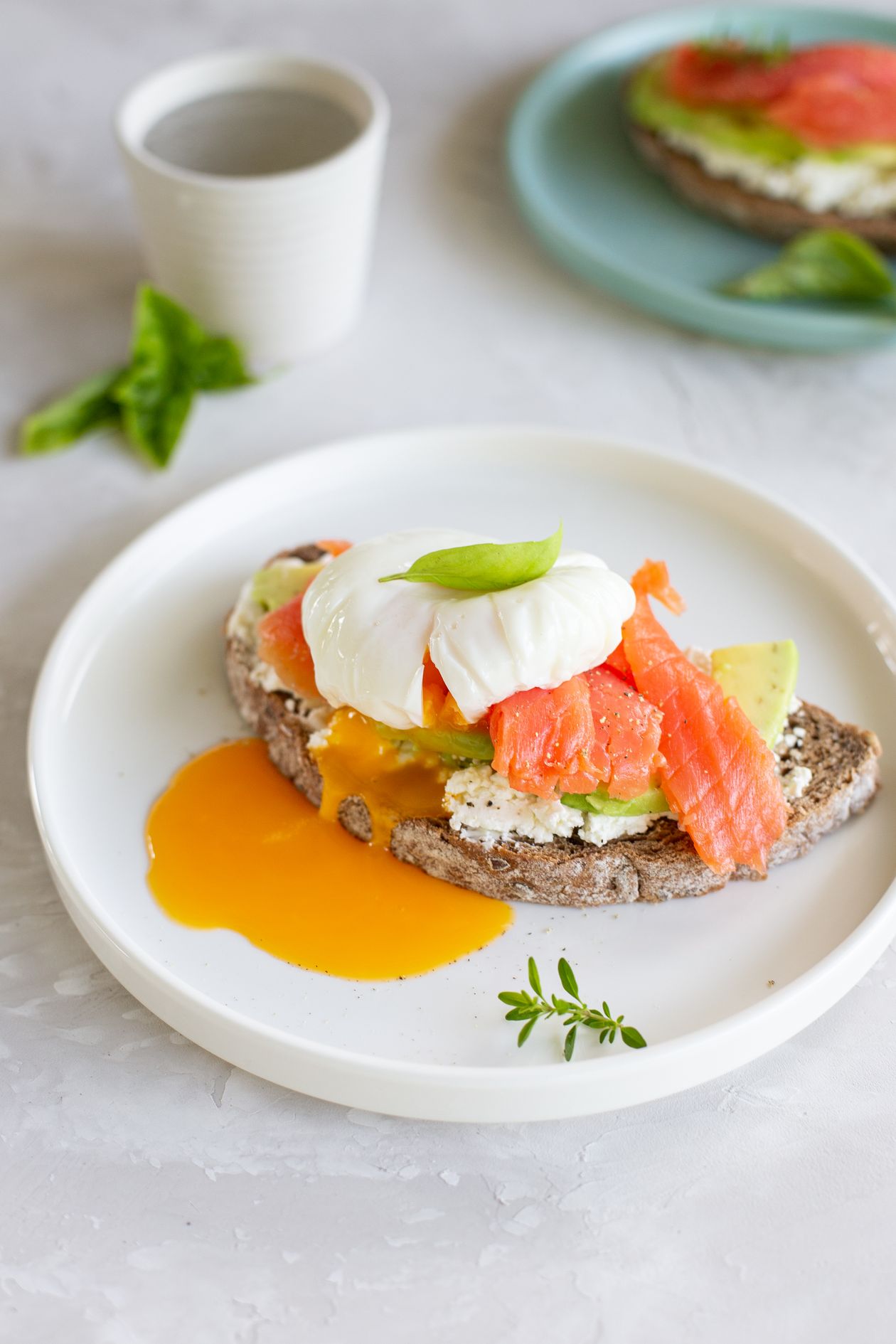
Avocado’s monounsaturated fat slows gastric emptying by stimulating duodenal lipid receptors, extending the physical fullness signal via vagal mechanoreceptors. Smoked salmon adds EPA and DHA alongside 15g of protein in a 3-ounce serving. Add a tablespoon of cottage cheese as a topping and the casein fraction extends amino acid delivery well past the first hour. Together they trigger satiety through at least three separate physiological pathways in one simple dish.
What’s in it: 1 avocado (halved, pitted), 2 oz smoked salmon, 1 soft-boiled egg (halved), 1 tbsp cottage cheese, fresh dill, lemon squeeze, flaky salt.
6. Basil Smoked Salmon Frittata
Best for: Meal prep: 4 servings from one 20-minute bake
Six eggs and 3 oz of smoked salmon divided across 4 servings gives roughly 12 to 15g of protein per slice from those two ingredients alone. Add 2 tablespoons of cottage cheese per serving on the side and you’re at 37 to 40g total, well past the threshold.
Frittatas reheat in 90 seconds and hold their texture well. A 2013 analysis confirmed that moderate egg consumption raises HDL cholesterol rather than LDL, with dietary cholesterol from eggs having negligible impact on blood cholesterol in most people (Shin et al., Metabolism). Always add fresh basil leaves after reheating, not before: even microwave residual heat degrades eugenol quickly.
What’s in it: 6 eggs, 3 oz smoked salmon (torn), 1/4 cup cottage cheese folded in, olive oil, salt, fresh basil added post-reheat.
7. Chive Cottage Cheese Savory Pancakes
Best for: Portable casein-rich breakfast you can make ahead
The base is 1 cup of cottage cheese (25g protein) and 2 eggs (12.6g), totaling 37.6g before any toppings. No flour needed. Casein curds in cottage cheese firm up around the egg protein in the pan and hold together as a stable pancake structure.
Chives folded into the batter are the right herb choice here. Vitamin K1 survives moderate cooking far better than the volatile eugenol in basil or the carvone in dill, so chives are the practical herb for a cooked-batter application. Make a batch of 6 on Sunday, refrigerate, and reheat two each morning in a toaster oven.
What’s in it: 1 cup cottage cheese, 2 eggs, 3 tbsp chopped chives, pinch of salt, butter or coconut oil for pan.
Cottage cheese pancakes preserve the casein micelle structure inside a solid food matrix. Research shows solid protein formats delay gastric emptying longer than liquid ones with identical protein content, so blending cottage cheese into a smoothie is less satiating than eating it as a pancake.
Protein Per Serving: How the Ingredients Stack Up
You don’t need to hit 35g from one ingredient. Combining two sources is the practical approach.
| Protein Source | Serving | Protein | Digestion Peak | Best Herb Pairing |
|---|---|---|---|---|
| Cottage cheese | 1 cup | 25g | 3-5 hours (casein) | Chives or dill |
| Eggs (whole) | 2 large | 12.6g | 1-2 hours (whey fraction) | Basil or chives |
| Smoked salmon | 3 oz | 15g | 1-2 hours | Dill or basil |
| Cottage cheese + 2 eggs + 1 oz salmon | combined | 43g | 3-5 hours sustained | All three |
Protein Per Standard Serving vs. 35g Satiety Threshold
Sources: USDA FoodData Central (2024). 35g threshold from Leidy et al., AJCN, 2015.
Which One Should You Start With?
For maximum satiety with minimum effort, start with the cottage cheese bowl (idea 1). Two ingredients, no cooking, and the chives add Vitamin K and Vitamin C that improve iron absorption from the dairy itself.
For meal prep, the basil smoked salmon frittata (idea 6) gives you 4 breakfasts from one bake. Add fresh basil each morning after reheating and pair each slice with a tablespoon of cottage cheese to cross the 35g threshold.
All three herbs in this article (basil, chives, dill) grow well in a simple home hydroponic setup. See our beginner’s guide to hydroponics if you want to grow your own.
How much protein do I need at breakfast to stay full until lunch?
At least 35 grams. Below that threshold, studies find only mild changes in subjective hunger. At 35g and above, circulating GLP-1, PYY, and CCK rise significantly while ghrelin drops enough to change actual eating behavior later in the day (Leidy et al., AJCN, 2015). Cottage cheese plus a single egg or 1 oz of smoked salmon gets you there without overthinking portions.
Is cottage cheese a good high-protein breakfast?
Yes, and it is one of the best options available. Cottage cheese is approximately 80% casein protein, which forms a slow-digesting gel in your stomach and releases amino acids steadily for up to 7 hours (Boirie et al., PNAS, 1997). One cup provides around 25 grams. Add a single egg or small piece of smoked salmon and you are past the 35g satiety threshold with a breakfast that sustains you well past the lunch hour.
What hydroponic herbs work best in savory breakfasts?
Chives, dill, and basil are the three most useful. Chives deliver 212.7 mcg of Vitamin K1 per 100g (177% DV) and 58.1mg of Vitamin C, which overcomes calcium’s block on non-heme iron absorption from eggs and dairy. Fresh dill supplies quercetin and kaempferol to activate NRF2-driven antioxidant enzymes. Basil provides eugenol, which suppresses COX-2 and NF-kB inflammatory pathways, but only when added fresh after cooking.
Can I meal prep savory high-protein breakfasts?
Most work well 3 to 4 days ahead. Frittatas, baked eggs, and savory pancakes all reheat without losing much texture. Always add fresh herbs after reheating: heat destroys the volatile oils in basil and dill responsible for most of their health benefits. Smoked salmon is best added cold just before eating to preserve texture and the delicate EPA and DHA fats.
How does smoked salmon compare to eggs for protein quality?
Both rank at the top of protein quality measures. Whole eggs achieve a perfect 1.0 PDCAAS score, meaning they supply all nine essential amino acids in ideal ratios. Smoked salmon adds roughly 5.2g of complete protein per ounce plus EPA and DHA omega-3s. Research links regular EPA and DHA intake to a 20% lower risk of all-cause dementia and cognitive decline (Morris et al., 2005). Combined in one breakfast, they cover satiety, muscle maintenance, and brain health simultaneously.
Sources (7)
- Leidy, H.J. et al. (2015). The role of protein in weight loss and maintenance. American Journal of Clinical Nutrition, 101(6), 1320S-1329S. Retrieved 2026-06-15. https://academic.oup.com/ajcn/article/101/6/1320/4564389
- Boirie, Y. et al. (1997). Slow and fast dietary proteins differently modulate postprandial protein accretion. Proceedings of the National Academy of Sciences, 94(26), 14930-14935. Retrieved 2026-06-15. https://www.pnas.org/doi/10.1073/pnas.94.26.14930
- Morris, M.C. et al. (2005). Fish consumption and cognitive decline with age in a large community study. Archives of Neurology, 62(12), 1849-1853. Retrieved 2026-06-15. https://jamanetwork.com/journals/jamaneurology/fullarticle/789696
- Shin, J.Y. et al. (2013). Egg consumption in relation to risk of cardiovascular disease and diabetes. Metabolism, 62(7), 1041-1047. Retrieved 2026-06-15. https://www.metabolismjournal.com/article/S0026-0495(13)00022-4/abstract
- USDA FoodData Central. (2024). Egg, whole, raw, fresh. FDC ID: 748967. Retrieved 2026-06-15. https://fdc.nal.usda.gov/fdc-app.html#/food-details/748967/nutrients
- USDA FoodData Central. (2024). Fish, salmon, chinook, smoked. FDC ID: 175168. Retrieved 2026-06-15. https://fdc.nal.usda.gov/fdc-app.html#/food-details/175168/nutrients
- Hallberg, L. & Hulthen, L. (2000). Prediction of dietary iron absorption. American Journal of Clinical Nutrition, 71(5), 1147-1160. Retrieved 2026-06-15. https://academic.oup.com/ajcn/article/71/5/1147/4729341