Hydroponic Strawberries: How to Grow Sweet Berries Indoors
Grow hydroponic strawberries indoors: best day-neutral varieties, pH 5.8-6.2, and first harvest in 60-90 days. Plus the hand-pollination step beginners miss.
In this guide
- Can You Really Grow Strawberries Hydroponically?
- Which Strawberry Variety Should You Grow?
- What’s the Best Hydroponic System for Strawberries?
- What pH, EC, and Nutrients Do Strawberries Need?
- How Much Light, Heat, and Pollination Do They Need Indoors?
- When Do You Actually Get Strawberries?
- Frequently Asked Questions
- Start With One Variety
Most indoor strawberry failures aren’t a nutrient problem. They’re a variety problem. Beginners buy a random nursery strawberry, give it good light and clean feed, and still harvest nothing but leaves and runners. The fix is genetic. Pick a day-neutral variety, start from crowns instead of seed, dial in six numbers, and pollinate the flowers yourself. Do that, and you can pick sweet berries indoors year-round, with the first ripe fruit landing about 60 to 90 days after transplanting (Ohio State University).
This guide covers the whole chain: which variety, which system, the pH and EC targets by stage, the hand-pollination trick, and a realistic timeline. If you’re brand new to soilless growing, start with leafy greens first. Strawberries are a step up, because they fruit. For the full beginner-friendly crop lineup, see the best plants to grow hydroponically.
Some links in this article may be affiliate links. We earn a small commission if you purchase through them, at no extra cost to you.
The short version
- Pick a day-neutral variety (Albion, Seascape, San Andreas). June-bearing types can't fruit reliably indoors.
- Start from bare-root crowns or plugs, never seed.
- Hold pH 5.8-6.2; run feed EC from ~1.0 up to 1.4-1.8 mS/cm by stage. Strawberries are salt-sensitive (Ohio State).
- Hand-pollinate every 2-3 days, or flowers drop and berries come out misshapen.
- First berries arrive 60-90 days after transplant; day-neutrals then fruit for 5-6 months.
Can You Really Grow Strawberries Hydroponically?
Yes, and indoors a day-neutral plant can fruit for months straight. In a 2023 sole-source lighting study on ‘Albion’, raising light intensity from 200 to 450 µmol increased crown diameter by 18 to 64% and shoot mass by 38 to 80% (NCBI/PMC, 2023). Strong light plus stable feed is exactly what an indoor system delivers.
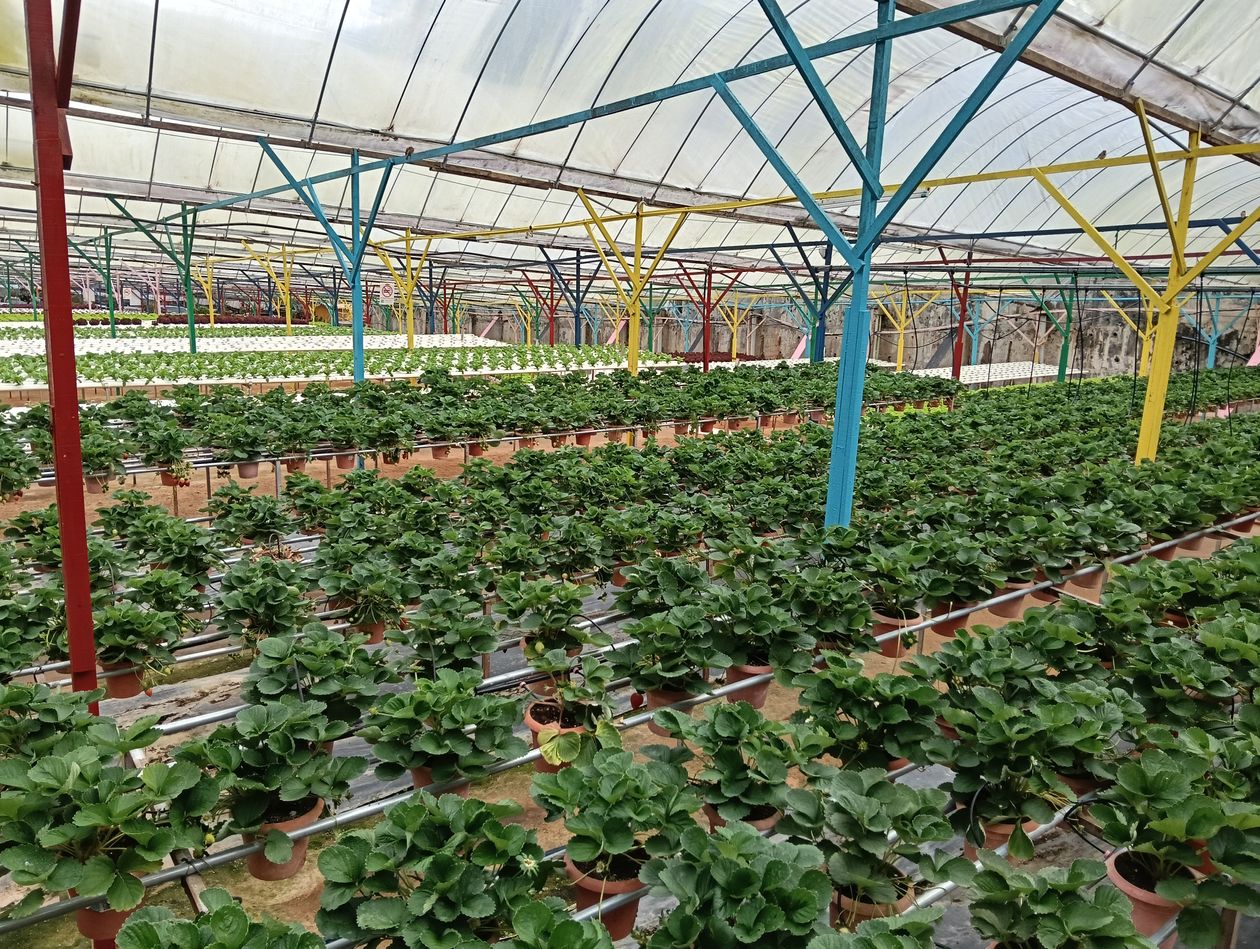
Soilless growing also fixes the things that ruin outdoor berries. There’s no soil-borne fungus, no slugs, and no rain to bruise the fruit. In vertical towers and channels, the berries dangle over the edge in dry air, so they stay clean and rot less. That’s why strawberries are the classic “next crop” once you’ve grown lettuce: higher value, more interesting, and genuinely doable on a windowsill scale.
The catch is that strawberries are fussier than greens in four specific ways: variety, pollination, salinity, and light. Get those right and the rest is routine.
Which Strawberry Variety Should You Grow?
Choose a day-neutral variety. It’s the single most important decision, and it’s where most indoor attempts quietly fail. Day-neutral plants flower and fruit regardless of day length, as long as temperatures stay moderate, roughly 50°F to 85°F (10°C to 29°C) (UMN Extension). That makes them the only sensible pick for continuous indoor cropping.
Day-neutral, everbearing, or June-bearing?
Strawberries split into three groups by how they respond to day length:
- June-bearing (short-day): Sets buds only when days drop below about 12 hours, paired with cooling autumn temperatures, and needs 8 to 10 weeks of winter chilling to bloom. In a warm, brightly lit room it never gets that trigger.
- Everbearing (long-day): Fruits in two or three separate flushes, with long gaps between. Workable, but inefficient indoors.
- Day-neutral: Ignores photoperiod and fruits continuously at moderate temperatures.
Here’s what most guides skip: a June-bearing plant indoors will look healthy and pump out runners while never setting fruit. People blame their nutrients or lights and rip the system apart, when the real problem was printed on the plant tag. Read the variety before you buy.
Best day-neutral cultivars
Albion is the flavor benchmark and resists Verticillium wilt, though it feeds heavily on nitrogen. Seascape is the most prolific and forgiving, which makes it a good first pick. San Andreas gives firm, uniform fruit with strong virus resistance and few runners. Quinault is an older, softer, very sweet everbearer with production gaps, so treat it as a flavor novelty rather than a workhorse.
One rule holds across all of them: don’t start from seed. Seeds are slow, need cold stratification, and vary genetically. Buy certified bare-root crowns or actively growing runner plugs instead.
What’s the Best Hydroponic System for Strawberries?
Three systems dominate, and substrate culture tends to out-yield pure water systems. A 2025 study found substrate-based setups produced higher strawberry yields than water-culture systems, largely because the media buffers moisture and oxygen around the roots (NCBI/PMC, 2025). Strawberry roots hate sitting in stagnant water, so aeration matters more than with leafy greens.
Your main options:
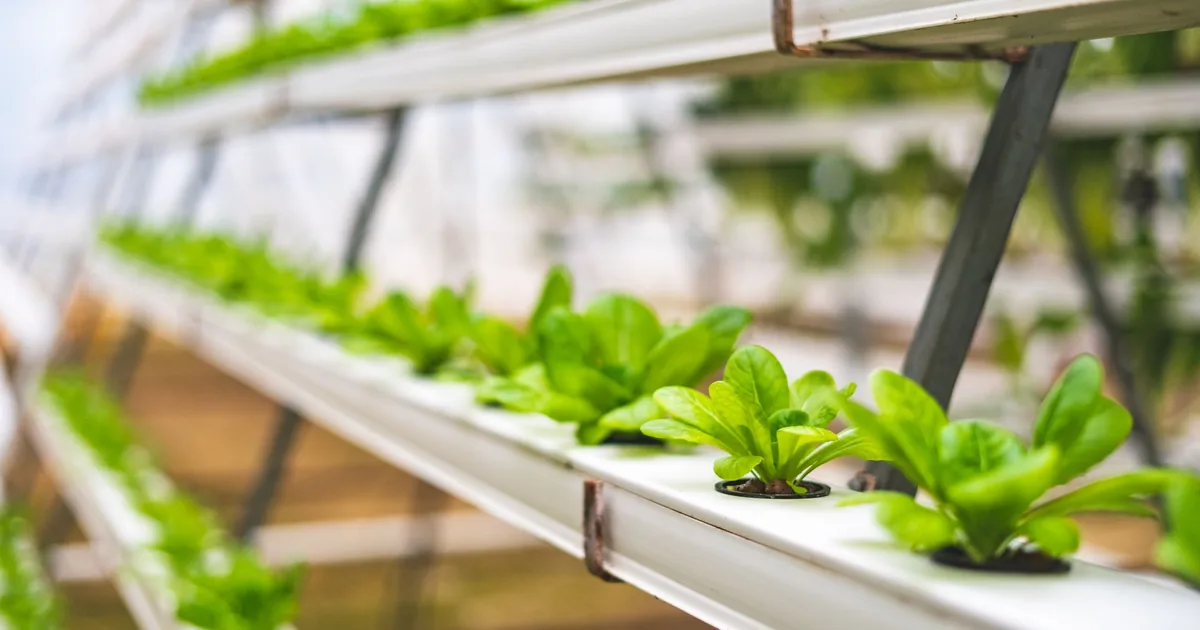
- Nutrient film technique (NFT): Plants sit in 4 to 6 inch channels on a gentle 1:30 to 1:40 slope, fed a thin film of solution at 1 to 2 liters per minute. Great for horizontal racks.
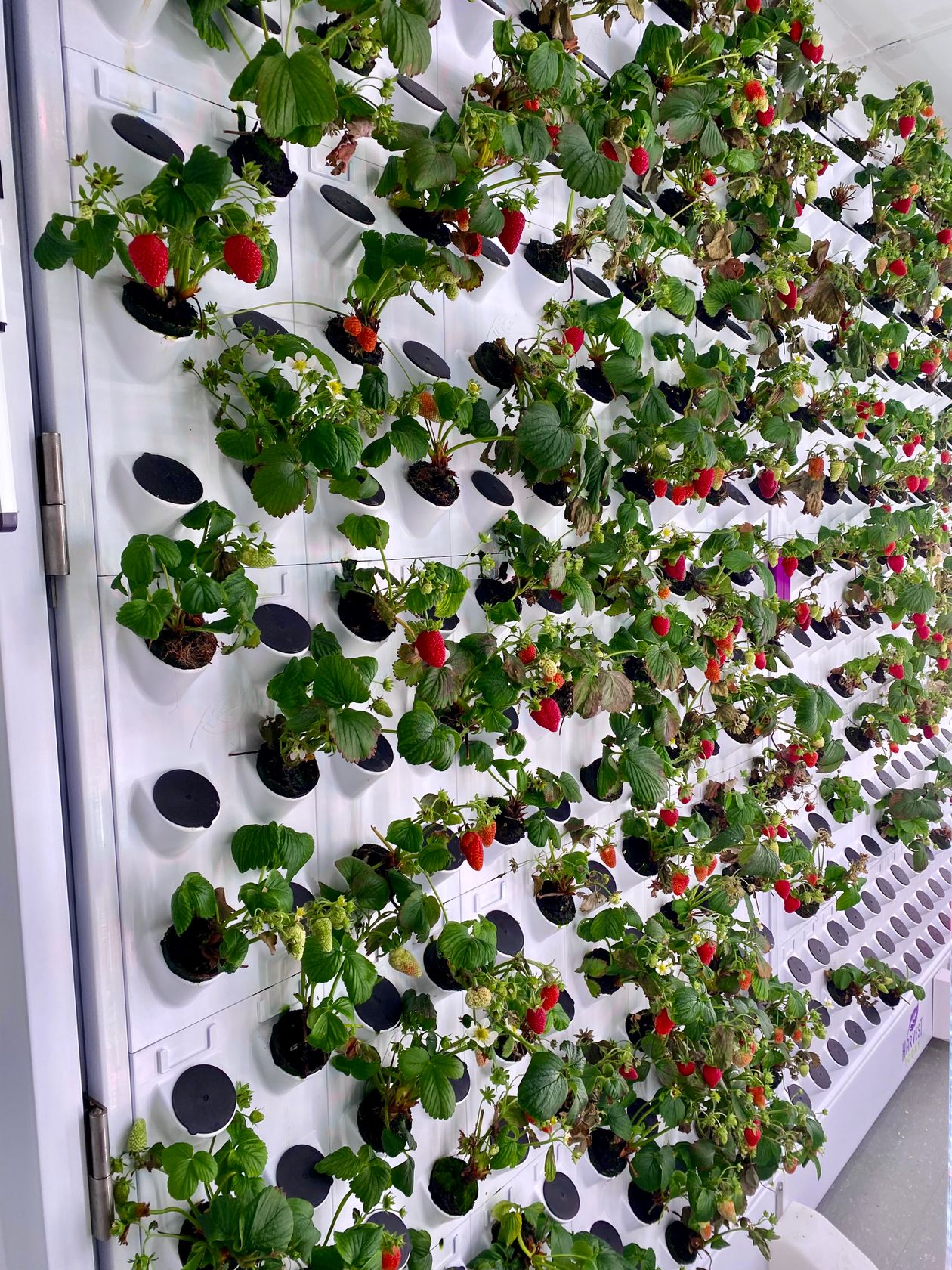
- Vertical towers: Stacked planting sites with the fruit hanging free. Best use of floor space, and the cleanest-looking berries.
- Substrate (Bato buckets or troughs): Plants grow in a mix like perlite, coco coir, and peat, drip-fed on a timer. The most stable choice for beginners.
For a low-cost first trial, the no-pump Kratky method can hold one or two plants, the same passive setup we used for growing romaine. Just know that passive systems lack active oxygenation, so yields stay modest.
Set the crown height exactly right
The number one physical killer is planting depth. The crown, the woody hub where leaves and flowers emerge, rots fast if it’s buried or submerged, because it suffocates and invites Phytophthora and anthracnose. Plant too shallow and the roots dry out. Set the plant so the media or water line sits right at the middle of the crown. Wash all nursery soil off the roots first, then seat them in clean media. If decay does set in, our full guide on crown and root rot covers the rescue steps.
What pH, EC, and Nutrients Do Strawberries Need?
Hold the solution at pH 5.8 to 6.2, and step EC up as the plant matures instead of running it flat. Strawberries are notably salt-sensitive, so excess EC in the root zone restricts water uptake and burns leaf margins (Ohio State University). A constant high EC also pushes the plant toward runners and leaves instead of flowers, which is the opposite of what you want.
Once fruiting starts, strawberries want a potassium-dominant feed, not the high-nitrogen mix that suits lettuce. A 2019 fertigation study in PLOS ONE found that balancing moderate nitrogen with elevated potassium produced over 110 grams of high-quality fruit per plant while improving the sugar-to-acid ratio (PLOS ONE / PMC, 2019). Keep ammonium under about 10% of total nitrogen, and don’t skimp on boron, because even a mild boron shortage stops pollen from working and gives you misshapen berries.
If coco coir is your substrate, rinse it thoroughly before planting. Raw coir is loaded with sodium and chloride that push EC up before you’ve added a single nutrient. New to these numbers? Read pH and nutrients for beginners for the basics on mixing and adjusting.
How Much Light, Heat, and Pollination Do They Need Indoors?
Strawberries need long, bright days and, indoors, your hands. Run full-spectrum LEDs for 12 to 14 hours a day, positioned about 12 to 18 inches above the canopy. Under weak light, the plant aborts flower buds and just survives (NCBI/PMC, 2023). Aim for a daily light integral around 17 to 20 mol per square meter for steady fruiting.
Temperature controls sweetness. Keep days at roughly 65°F to 80°F (18°C to 27°C) and nights cooler, around 50°F to 60°F (10°C to 15°C). Cool nights slow respiration so the plant keeps the sugars it made during the day, which means firmer, sweeter berries. Daytime heat above about 85°F (29°C) damages pollen and drops flowers.
How to hand-pollinate indoors
Strawberry flowers are “perfect,” carrying both the pollen-bearing stamens on the outer ring and the receptive pistils in the green center. But pollen still needs a physical nudge to move, and indoors there’s no wind or bees to do it (University of Arizona CEAC). Each tiny seed on the surface has to be fertilized, or that patch of the berry stays flat and hard, which is why poorly pollinated fruit comes out lumpy.
Do this while the plant is in bloom:
- Wait for late morning, a few hours after the lights come on, when flowers are fully open and pollen is dry.
- Use a soft brush, an artist’s paintbrush or clean makeup brush. Stiff bristles bruise the flower.
- Swirl the outer ring of yellow stamens to load the brush with pollen.
- Spiral across the green center, spreading pollen evenly over the pistils.
- Repeat every 2 to 3 days so each newly opened flower gets pollinated in time.
One overlooked detail prevents tipburn, the brown leaf and calyx edges that frustrate so many indoor growers. Tipburn is a calcium delivery problem, not a calcium shortage. Calcium only moves where water moves, so fast-transpiring mature leaves grab it all and the young enclosed tips get none (Ohio State University). Raising humidity to around 85 to 90% for a few hours at night closes the stomata, builds root pressure, and pushes calcium-rich sap into those growing tips. You’ll see morning dew droplets on the leaf edges when it’s working.
When Do You Actually Get Strawberries?
Plan on 60 to 90 days from transplant to your first ripe berry, then continuous flushes after that (Ohio State University). The timeline runs in four clear phases:
- Days 1 to 14, establishment: Roots take hold and the first leaves push out. Run a low EC near 1.0 to protect tender root hairs.
- Days 15 to 45, canopy building: Leaves and crown bulk up. Pinch off any early flower buds and snip every runner at the base. Both steal energy from future fruit.
- Days 45 to 60, flowering: Let flower clusters develop, raise EC, and start hand-pollinating as blooms open.
- Days 60 to 90, fruiting: Pollinated flowers swell and ripen over 4 to 6 weeks. First berries are usually ready by day 60 to 75, with peak production around day 90.
If lower leaves go pale during this stretch, check EC before adding anything, since the cause is often a feed that’s run too lean. Our guide to yellowing leaves walks through the full diagnosis. And once the harvest rolls in, those fresh berries are perfect for fruit-forward breakfast ideas.
Frequently Asked Questions
How long do hydroponic strawberries take to grow?
Grown from bare-root crowns or plugs, hydroponic strawberries produce their first ripe berries 60 to 90 days after transplanting. Once established, day-neutral varieties keep flowering and fruiting in continuous flushes for 5 to 6 months (Ohio State University).
Can you grow strawberries from seed hydroponically?
You can, but it’s a poor choice. Strawberry seeds germinate slowly, often need cold stratification, and show high genetic variability, so plant vigor and fruit quality are unpredictable. Bare-root crowns or runner plugs give you uniform, faster, disease-free plants instead.
Why are my indoor strawberries flowering but not fruiting?
Two usual causes: no pollination, or the wrong variety. Indoors there’s no wind or bees, so you must hand-pollinate every 2 to 3 days with a soft brush. If plants make runners but never flower, you likely have a June-bearing type that needs cold and short days to bloom.
What pH and EC do hydroponic strawberries need?
Hold the nutrient solution at pH 5.8 to 6.2. Run feed EC around 1.0 mS/cm at transplant, rising to 1.4 to 1.8 mS/cm during fruiting. Strawberries are salt-sensitive, so leach coco coir before planting and watch for leaf-edge tipburn (Ohio State University).
Do hydroponic strawberries need to be hand-pollinated indoors?
Yes. Strawberry flowers have both male and female parts but still need a physical agent to move pollen. Indoors, use a soft brush every 2 to 3 days. Skip it and flowers drop or set small, hard, misshapen berries, because each surface seed must be fertilized (University of Arizona CEAC).
Start With One Variety
Strawberries reward a little extra care that lettuce never asks for. But none of it is hard once you know the order of operations: pick a day-neutral variety, start from crowns, hold pH 5.8-6.2 and step your EC up by stage, give them 12 to 14 hours of strong light with cool nights, and brush-pollinate every couple of days. Get those right and you’ll be picking clean, sweet berries indoors while the outdoor patch is still under frost.
Pick one variety, start one plant, and learn its rhythm before you scale up the tower.
Sources (10)
- Ohio State University, Controlled Environment Berry Production: Production Cycle, retrieved 2026-06-19, https://u.osu.edu/indoorberry/production-cycle/
- Ohio State University, Controlled Environment Berry Production: Substrate Systems, retrieved 2026-06-19, https://u.osu.edu/indoorberry/substrates/
- Ohio State University, Controlled Environment Berry Production: Environment, retrieved 2026-06-19, https://u.osu.edu/indoorberry/environment/
- Ohio State University, Controlled Environment Berry Production: Tipburn, retrieved 2026-06-19, https://u.osu.edu/indoorberry/tip-burn/
- NCBI / PMC, Substrate System Outperforms Water-Culture Systems for Hydroponic Strawberry Production, 2025, retrieved 2026-06-19, https://pmc.ncbi.nlm.nih.gov/articles/PMC11860082/
- PLOS ONE / PMC, Optimal Fertigation for High Yield and Fruit Quality of Greenhouse Strawberry, 2019, retrieved 2026-06-19, https://pmc.ncbi.nlm.nih.gov/articles/PMC7112228/
- NCBI / PMC, Growth, Flowering, and Fruit Production of Strawberry ‘Albion’ in Response to Photoperiod and Photosynthetic Photon Flux Density of Sole-Source Lighting, 2023, retrieved 2026-06-19, https://www.ncbi.nlm.nih.gov/pmc/articles/PMC9965992/
- University of Minnesota Extension, Day-Neutral Strawberries, retrieved 2026-06-19, https://extension.umn.edu/strawberry-farming/day-neutral-strawberries
- University of Arizona CEAC, Hydroponic Strawberry Information: Pollination, retrieved 2026-06-19, https://cales.arizona.edu/strawberry/Hydroponic_Strawberry_Information_Website/Pollination.html
- ISHS / Acta Horticulturae, Effect of Different Nutrient Solution EC During Growth Stages on Fruit and Vegetative Characteristics of Strawberry in Hydroponic System, retrieved 2026-06-19, https://ishs.org/ishs-article/1315_78/